
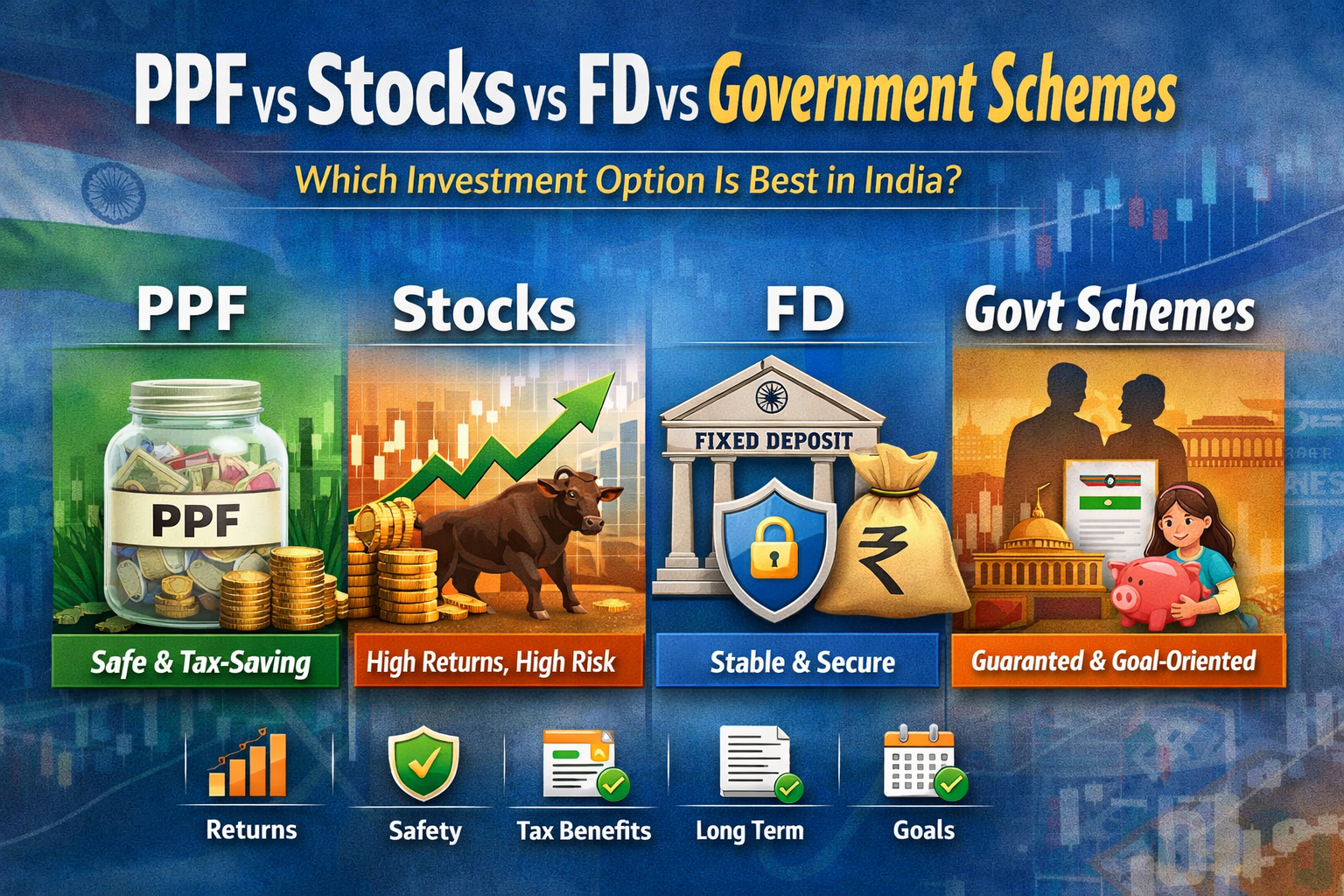
When it comes to investing in India, most people do not start with one question. They start with confusion.
Should you put money in PPF because it is safe and tax-friendly? Should you choose fixed deposits because they feel familiar? Should you invest in stocks because everyone talks about wealth creation? Or should you trust government schemes because they offer security and peace of mind?
This is where many investors get stuck. They compare all options as if they are competing for the same purpose. In reality, they are not. A Public Provident Fund, equity stocks, fixed deposits, and government-backed savings schemes are built for different needs. One may suit long-term wealth creation, another may protect capital, and another may support retirement or regular income.
That is why the right question is not simply, “Which investment is best?” The smarter question is, “Which investment is best for my goal, time horizon, and risk capacity?”
In this detailed guide, we will compare PPF vs stocks vs FD vs government schemes from the perspective of an Indian investor. You will understand how each option works, where each one fits, what mistakes to avoid, and how to choose wisely based on your financial needs.
This article is especially useful for beginners and intermediate investors who want practical clarity instead of generic advice. And yes, while many people speak to a stock Broker only when they want to buy shares, a good stock Broker can also help investors understand how market-linked investments fit into a larger financial plan. That matters because no single product can solve every financial need.
Why Comparing PPF, Stocks, FD, and Government Schemes Matters
Indian households traditionally prefer safety. That is why bank deposits and guaranteed return products remain popular. At the same time, inflation keeps increasing the cost of living, and that changes the game.
Money lying in a low-return product may feel safe, but if it does not grow faster than inflation over time, your purchasing power weakens.
That is why comparing these investment options matters:
- Some options focus on capital protection
- Some focus on steady income
- Some focus on tax savings
- Some focus on long-term wealth creation
- Some are suitable for senior citizens
- Some are ideal for retirement planning
- Some work best for disciplined monthly savings
If you mix up the purpose, you may choose the wrong investment even if the product itself is good.
For example:
- Putting all long-term money only in FD may keep returns too low
- Putting emergency money in stocks may expose you to unnecessary volatility
- Locking all your savings into long-tenure schemes may hurt liquidity
- Ignoring tax treatment may reduce real returns
So before comparing returns, we need to understand each product in its proper role.
What Is PPF and How Does It Work in India?
Is PPF only a tax-saving product, or is it also a long-term investment?
PPF, or Public Provident Fund, is one of the most trusted long-term savings options in India. It is backed by the Government of India and is especially popular among salaried individuals, self-employed people, and conservative savers.
PPF is not just a tax-saving tool. It is also a disciplined long-term investment designed to build a corpus over time with sovereign-backed safety.
Key features of PPF
- 15-year lock-in period
- Government-backed
- Interest rate revised periodically by the government
- Annual investment limit applies
- Eligible for tax benefits under Section 80C
- Interest earned is tax-free
- Maturity amount is tax-free
This tax treatment makes PPF part of the EEE category in common financial discussions: exempt on investment, exempt on interest, and exempt on maturity.
Who should consider PPF?
PPF is suitable for:
- Conservative investors
- People planning for long-term goals
- Individuals wanting tax-efficient fixed-income allocation
- Those who want disciplined savings without market risk
- Parents creating a long-term safety corpus
- Self-employed individuals without EPF benefits
Where does PPF fall short?
PPF has clear benefits, but it also has limitations:
- Long lock-in reduces flexibility
- Returns are stable but not aggressive
- It may not beat equity over long periods
- Not ideal for short-term goals
- Partial withdrawal rules apply only after certain years
So PPF is excellent for safety-oriented long-term planning, but not sufficient as the only investment vehicle for wealth creation.
What Are Stocks and Why Do They Attract Investors?
Why do stocks offer higher return potential than traditional savings products?
Stocks represent ownership in a company. When you invest in shares, you participate in the growth, profits, and valuation changes of that business.
This is why stocks are fundamentally different from PPF, FD, or most government schemes. Their returns are not fixed. They depend on business performance, economic conditions, investor sentiment, and time in the market.
Over long periods, equities have historically been one of the best tools for beating inflation and building wealth. But the path is not smooth.
What makes stock investing powerful?
Stocks can generate returns in two main ways:
- Capital appreciation: the share price rises over time
- Dividends: some companies distribute part of their profits
If you invest in quality businesses and stay invested with patience, stocks can potentially create much larger wealth than fixed-return products.
Why are stocks risky?
Because stock prices move daily. Sometimes sharply.
Risks include:
- Market volatility
- Company-specific risk
- Sector risk
- Economic slowdowns
- Poor investment decisions
- Emotional buying and panic selling
This is why beginners should not enter the stock market with the idea that it is a quick-money machine.
A reliable stock Broker can provide market access, platform tools, research support, and execution convenience, but investment success still depends on discipline, knowledge, and proper asset allocation. A responsible stock Broker should not be seen as a shortcut to guaranteed returns.
Who should invest in stocks?

Stocks are generally suitable for:
- Investors with long-term goals
- People who can tolerate market fluctuations
- Those aiming for inflation-beating growth
- Investors building wealth for 7 years, 10 years, or more
- Individuals who already have emergency savings and stable cash flow
Who should be careful with direct stock investing?
Direct stock investing may not suit:
- People needing money in the short term
- Very conservative investors
- Those who panic when markets fall
- Investors with no research discipline
- People who chase tips and rumors
For many people, equity mutual funds may be a better starting point than direct stock selection. Still, understanding stocks is important because they remain one of the strongest long-term wealth-building tools in India.
What Is an FD and Why Do So Many Indians Still Prefer It?

Why do fixed deposits remain popular despite lower long-term return potential?
Fixed Deposits, or FDs, are among the most familiar investment products in India. Banks and NBFCs offer them, and they are widely used by families for safety, regular income, and peace of mind.
With an FD, you deposit a lump sum for a fixed tenure and earn a pre-decided interest rate.
What makes FDs attractive?
People prefer FDs because they are:
- Easy to understand
- Predictable in return
- Available for different tenures
- Less volatile than market-linked products
- Useful for short- to medium-term planning
- Suitable for risk-averse investors
For many households, the emotional comfort of knowing the exact maturity value matters more than chasing higher returns.
Are FDs risk-free?
Not entirely. They are low-risk compared to equities, but not equal to sovereign-backed products.
There are a few things investors should remember:
- Bank FD interest is taxable
- Premature withdrawal may attract penalty
- Inflation can reduce real return
- Not all deposit institutions carry equal strength
- Corporate FDs may carry higher risk than bank FDs
When does an FD make sense?
FDs work well for:
- Parking short-term funds
- Creating stability in a portfolio
- Planning near-future expenses
- Senior citizens looking for regular interest income
- Investors who want a conservative allocation
When is relying only on FD a mistake?
If your entire long-term financial life depends only on FDs, you may face a problem: your money may grow too slowly.
That means:
- Retirement corpus may fall short
- Education goals may become expensive
- Inflation may outpace returns
- Wealth creation may remain weak
So FD is useful, but usually not enough as a complete investment strategy.
What Are Government Schemes and Which Ones Do Indian Investors Commonly Use?
Are all government schemes the same?
No. This is a very important point.
When people say “government schemes,” they often club many different products together. But these schemes serve different investors and different purposes.
Some major government-backed or government-supported savings options include:
- Senior Citizens’ Savings Scheme (SCSS)
- Sukanya Samriddhi Yojana (SSY)
- National Savings Certificate (NSC)
- Post Office Monthly Income Scheme (POMIS)
- Kisan Vikas Patra (KVP)
- RBI Floating Rate Savings Bonds
- Employees’ Provident Fund (EPF), where applicable
- National Pension System (NPS), though market-linked in part and structurally different
Each has different rules for:
- Tenure
- return mechanism
- eligibility
- taxation
- withdrawal conditions
- use case
Which government schemes are most useful for common investors?

Senior Citizens’ Savings Scheme (SCSS)
Best suited for senior citizens seeking regular income with government-backed comfort.
Sukanya Samriddhi Yojana (SSY)
Designed for the girl child. Popular for long-term disciplined savings with tax benefits and attractive structure.
National Savings Certificate (NSC)
A fixed-income saving option with a specific tenure, often chosen for predictable returns and tax planning.
Post Office Monthly Income Scheme (POMIS)
Useful for investors seeking regular monthly income from a safer instrument.
RBI Savings Bonds
Suitable for conservative investors who want government-backed interest income over a defined period.
Why do investors like government schemes?
Because they offer:
- High trust
- Safety perception
- defined framework
- suitability for conservative goals
- in some cases, attractive rates relative to traditional bank deposits
- better alignment for specific categories such as senior citizens or parents
What are the limitations of government schemes?
- Lock-in may be restrictive
- Eligibility may be limited
- Some schemes are goal-specific
- Liquidity may be lower than expected
- Tax treatment varies
- Returns may still lag equity over long periods
So government schemes are strong tools, but they are not one-size-fits-all solutions.
PPF vs Stocks vs FD vs Government Schemes: What Is the Core Difference?
Before going deeper, let us make the basic comparison clear.
What are you really comparing here?
You are comparing four broad investment styles:
| Investment Option | Nature | Risk Level | Return Type | Liquidity | Best For |
|---|---|---|---|---|---|
| PPF | Government-backed long-term savings | Low | Fixed, government-declared | Low to moderate | Tax saving, long-term safe corpus |
| Stocks | Market-linked equity ownership | High | Variable, potentially high | High | Long-term wealth creation |
| FD | Bank/NBFC deposit | Low to moderate | Fixed | Moderate | Capital preservation, short/medium term |
| Government Schemes | Government-backed savings instruments | Low | Usually fixed or administratively set | Depends on scheme | Safety, retirement, child planning, regular income |
This table gives the overview, but the real answer depends on what you need the money for.
Which Investment Option Gives Better Returns in India?
Should return be the first thing you compare?
Most people start with returns, but return alone is a poor decision-making metric.
A product giving lower return with better tax efficiency, safety, or suitability may be more useful than a product promising a higher but unstable return.
Still, return comparison matters, especially when building long-term wealth.
How do these investment options compare on return potential?
Stocks
Stocks have the highest long-term return potential among the four, but they also carry the highest risk and volatility. There is no guaranteed return. Some investors do very well, while others lose money due to poor selection, timing mistakes, or lack of patience.
PPF
PPF usually offers stable and government-backed returns. It is not meant to outperform equities. Its strength lies in consistency, tax efficiency, and safety over a long holding period.
FD
FD returns are fixed at the time of booking, but post-tax returns may become less attractive, especially for people in higher tax slabs.
Government Schemes
Government schemes vary. Some may offer attractive rates compared to normal deposits, especially for specific segments like senior citizens. But the exact benefit depends on the scheme, taxation, and tenure.
Which one usually wins over long periods?
For pure wealth creation over long periods, stocks generally have the strongest upside. But that comes with the condition that the investor can remain disciplined through volatility.
For stable, tax-efficient long-term fixed-income allocation, PPF can be very useful.
For short-term certainty, FD has a practical role.
For targeted goals like retirement income, girl child savings, or senior citizen income planning, selected government schemes may be more suitable than both PPF and FD.
Which Option Is Safer: PPF, FD, Stocks, or Government Schemes?
What does safety actually mean in investing?
Safety can mean different things:
- Safety of principal
- Safety of returns
- Safety from volatility
- Safety from inflation loss
- Safety from liquidity problems
This is where many investors get confused.
Which options are safest for capital protection?
From a principal protection angle, PPF and many government-backed schemes are considered highly safe because they carry sovereign backing.
Bank FDs are also widely perceived as safe, especially with reputed banks, but they are not identical to sovereign-backed products.
Stocks are the least safe in the short term because market prices can rise and fall sharply.
But is “safe” always truly safe?
Not necessarily.
For example:
- A low-return product may protect your capital but fail against inflation
- A long lock-in product may be safe but inconvenient if you need urgent money
- A market-linked product may look unsafe short term but build stronger real wealth over time
So the safest investment depends on what risk you are trying to avoid.
Which Investment Is Better for Tax Saving?
Is tax saving the same as wealth creation?
No. This is one of the biggest mistakes investors make.
A product can save tax but still may not be the best long-term wealth creator for your overall financial plan.
Which of these options help in tax planning?
PPF
One of the strongest tax-saving products in India because of its EEE-style tax treatment and Section 80C eligibility.
Certain government schemes
Some government schemes such as NSC, SSY, and others may offer tax benefits depending on the applicable rules and sections. Their final attractiveness depends on both tax treatment and goal suitability.
FD
Only tax-saving FDs qualify under Section 80C, and they come with lock-in conditions. Regular FDs do not offer this tax-saving advantage in the same way.
Stocks
Direct stock investments do not offer Section 80C tax-saving benefit. However, their taxation framework is different from fixed-income products, and long-term wealth creation may still be superior depending on the holding period and return achieved.
What should investors remember?
Never buy a product only because someone said, “It saves tax.”
Ask:
- Does it fit my goal?
- Is the lock-in acceptable?
- What is the post-tax return?
- Is it for saving tax or building wealth?
- Do I already have enough fixed-income exposure?
That small shift in thinking can prevent many poor decisions.
Which Option Is Better for Long-Term Wealth Creation?
If your goal is to build real wealth, what should you prioritize?
For long-term wealth creation, the conversation changes. You need to think beyond safety and ask whether your investment can outpace inflation and create meaningful growth.
In this context, stocks usually stand out.
Why are stocks generally preferred for long-term growth?
Because businesses grow, profits grow, and over time, equity markets reflect that growth. This is why equity participation has historically been central to long-term wealth building.
A trusted stock Broker can help investors access the market, place orders efficiently, and track portfolios, but long-term success depends more on strategy than on trading activity. The best outcomes generally come from patience, quality selection, and disciplined investing, not constant buying and selling through a stock Broker platform.
Does that mean PPF, FD, and government schemes are poor choices?
Not at all.
They are simply not built for the same role.
Think of them like this:
- Stocks help grow wealth
- PPF helps create tax-efficient long-term safety
- FD helps preserve capital and maintain certainty
- Government schemes help achieve specific secure goals
The strongest portfolios are often not built by choosing one option and rejecting all others. They are built by using each option intentionally.
Which Investment Is Better for Short-Term Goals?
What if you need the money in 1 to 3 years?
If your goal is short term, chasing stock market returns can be risky.
Suppose you need money for:
- a home down payment
- school admission
- medical reserve
- business working capital
- marriage expenses in the near future
In such cases, capital preservation matters more than return maximization.
Which options are usually better for short-term use?
For short-term goals, investors often prefer:
- bank FDs
- certain short- or medium-term fixed-income instruments
- liquid and low-volatility options depending on suitability
- specific government-backed options if tenure aligns
PPF is usually not ideal for short-term goals because of its long lock-in structure.
Stocks are also not ideal for short-term certainty because markets may fall exactly when you need the money.
Which Option Is Better for Retirement Planning in India?
Should retirement money be kept fully safe or allowed to grow?
Retirement planning in India requires balance.
If you keep everything in low-return products, your corpus may not grow enough.
If you keep everything in equities, volatility may become uncomfortable, especially close to retirement.
How should retirement investors think?
A practical approach is usually layered:
- growth-oriented investments for long-term accumulation
- stable fixed-income products for security
- income-generating schemes after retirement
- tax-efficient allocation where possible
Where does each product fit in retirement?
Stocks
Useful in the accumulation phase, especially when retirement is many years away.
PPF
Useful as a conservative long-term tax-efficient component.
FD
Useful for near-retirement capital stability or parking funds.
Government schemes
Very useful post-retirement, especially for regular income and capital safety, depending on eligibility.
This is also where guidance matters. Many investors approach a stock Broker for equity exposure but forget that retirement planning requires broader thinking than just buying stocks. A good stock Broker conversation should be part of a larger investment decision, not the whole plan.
What Are the Biggest Mistakes People Make While Choosing Between These Investment Options?
Why do investors often choose the wrong product?
Usually because they focus on one factor and ignore the rest.
Here are the most common mistakes.
Choosing only on the basis of return
High return without understanding risk can lead to regret.
Choosing only on the basis of safety
Too much safety can quietly damage long-term wealth because of inflation.
Ignoring taxation
Pre-tax return and post-tax return are not the same thing.
Ignoring liquidity
An investment may be good on paper but painful if money is locked when urgently needed.
Mixing investment purpose
Emergency fund, retirement corpus, tax saving, and wealth creation should not be treated as identical goals.
Investing in stocks without preparation
Opening a trading account with a stock Broker is easy. Building a disciplined stock portfolio is not. Many beginners confuse access with expertise.
Putting all money in one product
Concentration increases risk, even in “safe” categories, because different goals need different structures.
How Should a Beginner Decide Between PPF, Stocks, FD, and Government Schemes?
What questions should you ask before investing?
Instead of asking which product is best in general, ask these practical questions:
What is the goal of this money?
Is it for emergency use, tax saving, retirement, child education, income generation, or long-term wealth building?
When will I need this money?
Your time horizon changes everything.
How much risk can I realistically handle?
Not theoretical risk. Real emotional risk. Can you stay calm if your investment falls 20% or more?
Do I need liquidity?
If yes, lock-in products must be chosen carefully.
What is my tax bracket?
Tax treatment can materially change effective return.
Am I trying to protect money or grow it?
Both are valid goals, but they require different tools.
A simple way to think about allocation
A beginner can think in layers:
- Emergency and near-term money: safer and more liquid products
- Medium-term planned expenses: stable instruments with predictability
- Long-term growth money: equity-oriented approach
- Tax-efficient long-term safety: PPF and relevant government-backed products
- Goal-specific planning: appropriate government scheme based on eligibility and purpose
That is far smarter than forcing one product to do every job.
PPF vs Stocks vs FD vs Government Schemes: Pros and Cons
PPF: Pros and Cons
Pros
- Government-backed safety
- Strong tax efficiency
- Suitable for long-term disciplined saving
- Helps conservative investors build stable corpus
- Good fixed-income component in a diversified portfolio
Cons
- Long lock-in
- Limited liquidity
- Moderate return potential
- Not suitable for short-term goals
- Not enough alone for aggressive wealth creation
Stocks: Pros and Cons
Pros
- Strong long-term wealth creation potential
- Can beat inflation over time
- High liquidity in listed shares
- Ownership in businesses
- Suitable for growth-oriented investors
Cons
- High volatility
- No guaranteed return
- Requires discipline and research
- Emotional mistakes can be costly
- Poor for short-term goal certainty
FD: Pros and Cons
Pros
- Simple and familiar
- Predictable returns
- Useful for short- and medium-term planning
- Helpful for conservative investors
- Easy to access
Cons
- Taxable interest
- Lower post-tax real return
- Inflation may reduce purchasing power
- Not ideal as sole long-term wealth strategy
- Premature withdrawal may carry penalty
Government Schemes: Pros and Cons
Pros
- Strong trust and safety perception
- Suitable for goal-specific planning
- Some schemes offer attractive structure for senior citizens or child planning
- Better fit for conservative investors
- Useful in retirement income planning
Cons
- Scheme rules vary widely
- Lock-in may be restrictive
- Eligibility limitations in some cases
- Tax treatment differs by scheme
- Not all schemes are ideal for wealth creation
So, Which Investment Option Is Best in India?
Is there one clear winner?
No. And that is the honest answer.
The best option depends on what you want the money to do.
Choose PPF if:
- You want long-term safe savings
- Tax efficiency matters
- You are comfortable with lock-in
- You want a conservative component in your portfolio
Choose stocks if:
- Your goal is long-term wealth creation
- You can tolerate volatility
- You have time on your side
- You understand that returns are not guaranteed
Choose FD if:
- You want stability and predictability
- Your goal is short- to medium-term
- You need lower risk and easier planning
- You do not want market volatility
Choose government schemes if:
- You need a purpose-specific safe investment
- You are planning for retirement income, senior citizen savings, or child-related long-term goals
- You value government-backed structure
- The scheme matches your eligibility and tenure needs
What is the smarter real-world answer?
For most Indian investors, the best strategy is not one option over another. It is a combination.
A balanced investor may use:
- stocks for growth
- PPF for long-term stability and tax efficiency
- FD for short-term certainty
- government schemes for specific life goals
That is how practical investing actually works.
Can You Build a Better Portfolio by Combining These Options?
Yes, absolutely.
This is often the most sensible path for Indian households.
A thoughtful portfolio does not ask one investment to do everything. It assigns roles.
For example:
- A young salaried investor may combine equities with PPF
- A family saving for both education and short-term obligations may combine stocks, FDs, and a government-backed scheme
- A retiree may rely more on government schemes and FDs, with limited equity exposure if suitable
- A self-employed professional may use PPF for stable long-term savings and equity for growth
This approach reduces dependence on any one return source and makes planning more realistic.
Even when working with a stock Broker, investors should remember that equity is only one part of a healthy financial structure. A capable stock Broker can help with market execution, but overall investment wisdom comes from aligning every rupee with a clear purpose.
Final Takeaway: What Should Investors Learn From This Comparison?
The debate around PPF vs stocks vs FD vs government schemes often becomes unnecessarily emotional. Some people say stocks are best because they build wealth. Others say government-backed options are best because they protect money. Both views are incomplete.
The truth is simple:
- Stocks are powerful for long-term growth
- PPF is excellent for safe, tax-efficient long-term saving
- FDs are useful for certainty and short-term planning
- Government schemes are valuable for specific secure goals
So the best investment option in India is not the one with the loudest marketing or the highest headline return. It is the one that fits your financial objective, risk appetite, tax situation, and time horizon.
If you are just starting, do not rush to pick a winner between all four. First define your goal. Then match the product to the purpose.
That single habit can improve your investment decisions far more than chasing the latest tip, trend, or promise.
And for investors exploring equity exposure through a stock Broker, the right mindset is not to ask, “Which stock will double fast?” It is to ask, “How do stocks fit into my overall plan alongside safer options like PPF, FD, and government schemes?” That is the question that leads to better financial decisions in the Indian market.
Key Takeaways at a Glance
- PPF is best for long-term safe and tax-efficient savings
- Stocks are best for long-term wealth creation and inflation-beating potential
- FDs are best for capital stability and near-term planning
- Government schemes are best for specific goals like retirement income, child planning, and senior citizen savings
- No single investment option is best for everyone
- The right mix depends on goal, tenure, tax treatment, liquidity needs, and risk tolerance
- A diversified strategy usually works better than choosing only one product
If you want, I can now turn this into a fully SEO-optimized blog format with meta title, meta description, FAQs, and schema-friendly Q&A section for your website.