
Introduction: When a ₹10,000 Share Becomes Two ₹5,000 Shares Overnight
Imagine, You log into your Demat account one morning and notice something that looks, at first glance, like a problem. The share price of a company you hold has been cut in half overnight. Naturally, your first reaction is panic — has something gone wrong? Has there been a massive sell-off? Did you miss an important announcement?
Then you look at your total portfolio value and realise it has not changed. You now hold twice the number of shares, but at exactly half the price. Your investment is worth exactly what it was worth yesterday.
What just happened is called a stock split — one of the most commonly misunderstood corporate actions in the Indian stock market. No money was lost. No business fundamental changed. The company simply decided to divide each existing share into multiple smaller shares, like slicing a pizza into more pieces without adding more dough.
But while the immediate financial impact on your investment is neutral, the implications of a stock split go far deeper. It affects liquidity, investor sentiment, market perception, and how institutional and retail investors interact with the stock going forward. In the Indian context, where stock prices of companies like MRF, Page Industries, and Honeywell Automation have historically traded in the range of thousands — sometimes over a lakh — per share, stock splits carry very real practical significance.
This article walks you through everything you need to know about stock splits: what they are, how they work mechanically, why companies do them, what actually changes and what does not, how Indian market examples play out, and what you — as an investor — should do when one is announced.
What Is a Stock Split? The Core Definition
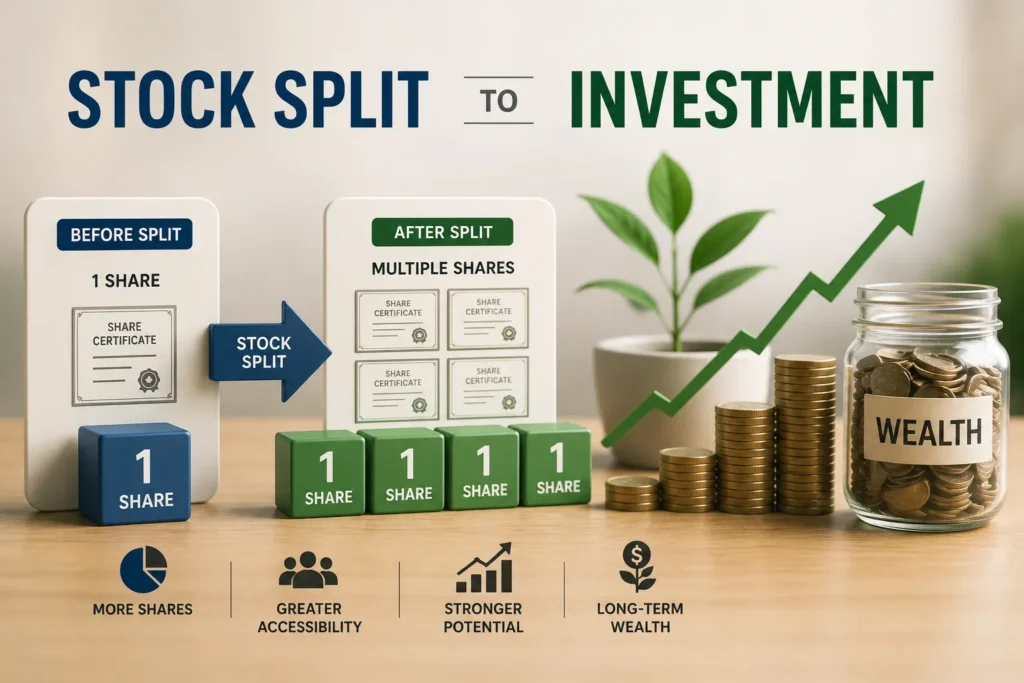
A stock split is a corporate action through which a company increases the total number of its outstanding shares by dividing each existing share into a fixed number of new shares. The split ratio determines how many new shares are created from each old share. A 2-for-1 split means every shareholder receives two shares for every one they previously held. A 5-for-1 split means five shares replace every one.
Critically, the total market capitalisation of the company does not change on account of the split alone. When the number of shares increases, the price per share decreases proportionally. If you held 100 shares of a company at Rs 2,000 per share — a total holding of Rs 2,00,000 — after a 2-for-1 stock split you hold 200 shares at Rs 1,000 per share. Your total holding remains Rs 2,00,000.
| Core Principle: A stock split changes the number of shares and their price proportionally. It does not change the total value of the company, the total value of your investment, or any business fundamental. |
How Is a Stock Split Different from a Bonus Issue?
This is one of the most common points of confusion for Indian investors, and understandably so, because both actions result in more shares being credited to your demat account. However, there is an important accounting distinction between the two.
| Stock Split | Bonus Issue |
| The face value of the share is reduced proportionally | The face value of the share remains unchanged |
| No new capital is created; existing shares are divided | New shares are issued from the company’s free reserves |
| Reserves are not capitalised in a split | Reserves are capitalised and transferred to share capital |
| E.g.: Face value drops from Rs 10 to Rs 5 in a 2-for-1 split | E.g.: Face value stays Rs 10; shareholder gets extra shares free |
| Total paid-up capital in rupee terms stays the same | Total paid-up capital in rupee terms increases |
| No accounting entry in retained earnings | Retained earnings or reserves reduce; share capital increases |
In simple terms: a stock split is purely a subdivision of existing shares, like breaking a Rs 100 note into two Rs 50 notes. A bonus issue is more like getting additional notes from a reserve you had kept aside. Both increase the share count, but through different mechanisms and with different accounting treatments.
How Does a Stock Split Work Mechanically?
Understanding the mechanics helps demystify what happens to your demat account when a split is announced. Let us trace the complete process, from the board decision to the day the new shares appear in your holding.
Step 1: Board of Directors Approves the Split
The process begins when a company’s board of directors passes a resolution recommending a stock split. The board specifies the split ratio — most commonly 2:1, 5:1, or 10:1 in India, though ratios like 3:1 and 4:1 also exist. This decision is driven by several strategic factors that we will explore in detail in the next section.
Step 2: Shareholder Approval via EGM or Postal Ballot
In India, altering the face value of shares — which is what a stock split technically does — requires amending the capital clause of the company’s Memorandum of Association. This requires shareholder approval, typically obtained through an Extraordinary General Meeting (EGM) or a postal ballot process. For listed companies, SEBI’s regulations require this approval before the split can be executed.
Step 3: Stock Exchange Notification and Record Date Announcement
Once shareholders approve the split, the company notifies BSE and NSE and announces a record date. The record date is the cutoff date — only shareholders who hold the stock as of this date are eligible to receive the additional shares created by the split. If you buy the stock after the record date, you receive shares at the post-split price and quantity directly.
Step 4: Ex-Split Date and Price Adjustment
The ex-split date is typically one trading day before the record date (given India’s T+1 settlement cycle). On the ex-split date, the stock’s price is adjusted by the exchanges to reflect the new face value. If a stock was trading at Rs 3,000 before a 3:1 split, the exchange adjusts the price to Rs 1,000 on the ex-split date. Historical price charts are also retroactively adjusted on most platforms so that the chart shows a continuous, comparable price history.
Step 5: New Shares Credited to Demat Accounts
After the record date, the additional shares are credited to the demat accounts of all eligible shareholders, typically within a few days. If you held 50 shares before a 2:1 split, you will find 100 shares in your account — 50 original shares that are now repriced at the new lower face value, and 50 additional shares.
| Practical Note: If you are using platforms like Zerodha, Groww, or Angel One, you may notice the share count update before you see the adjusted price, which can momentarily appear confusing. Both the price and quantity will normalise to their correct post-split values within the settlement timeline. |
Why Do Companies Announce a Stock Split?
Companies do not make stock split decisions lightly. There are usually clear strategic motivations behind the timing and decision. Understanding these reasons gives you insight into what management is signalling when they announce one.
Is It Simply to Make the Stock More Affordable?
The most cited reason for a stock split is price accessibility. When a stock trades at a very high price per share, it effectively excludes a large portion of potential investors — particularly retail investors — who may not be able to buy even a single share. In India, the minimum investment in a stock is one share (unlike mutual funds where you can invest any amount through SIPs), so share price has real consequences for accessibility.
Consider MRF Limited, which has famously never split its shares and trades above Rs 1 lakh per share — making it the most expensive stock on the Indian exchanges. For a retail investor who wants exposure to MRF, buying even one share requires committing over a lakh of rupees. If MRF were to split its shares, even a Rs 5,000 or Rs 10,000 entry becomes possible for a much wider audience.
Companies that want to expand their retail investor base, increase daily trading volumes, or prepare for inclusion in indices that have market-lot considerations, often use stock splits to bring their price into a more comfortable range.
Does a Lower Share Price Actually Increase Liquidity?
Yes — and this is one of the most concrete, measurable outcomes of a stock split. Liquidity in stock market terms refers to how easily you can buy or sell a stock without significantly affecting its price. A stock with thin trading volume — few buyers and sellers on any given day — is considered illiquid.
When a stock’s price is reduced through a split, more participants can afford to trade it. Both the average transaction size and the number of daily transactions typically increase post-split. This benefits all shareholders because better liquidity means tighter bid-ask spreads and easier entry and exit. For institutional investors, better liquidity also means they can build or reduce positions without causing excessive price impact.
Does a Stock Split Signal Management’s Confidence?
In practice, yes — though not in an absolute sense. Companies generally announce stock splits when they are in a strong financial position and their share price has appreciated significantly. A company whose stock has risen from Rs 200 to Rs 2,000 over five years might announce a 10:1 split. The act of splitting signals that management believes the business will continue to grow and that the current price appreciation is sustainable — otherwise there would be no point in making the stock more accessible.
This is why stock split announcements often come with a mild positive market reaction — not because the split itself creates value, but because it is an implicit signal from management about their confidence in the business. Investors interpret it as: “The company does not expect the price to fall back to pre-appreciation levels.”
Is It Also About Index Inclusion and Institutional Interest?
Absolutely. Index committees and institutional fund managers sometimes have internal guidelines or mandated limits on how much capital they can deploy in a single share. A very high share price can make position-building mechanically cumbersome. Additionally, some indices use price-weighted calculations where a very high-priced stock would dominate the index composition inappropriately. Bringing the price into a more moderate range through a stock split can make the company more practically accessible to a wider range of institutional and index investors.
Real Indian Examples of Stock Splits and What Happened
Theory makes more sense with real examples. Here are some well-known Indian stock split instances that illustrate the practical dynamics:
| Company | Split Ratio & Approx. Year | Context |
| Infosys Ltd. | 2:1 (multiple times over the years) | Infosys has split its shares multiple times as the price appreciated significantly. Each split brought the stock within easier reach of retail investors and helped maintain robust trading volumes. |
| Reliance Industries | 1:2 (2017) | Reliance split its shares in a 1:2 ratio, doubling the share count and halving the price. The move coincided with a period of renewed investor interest and helped widen its retail shareholder base. |
| HDFC Bank | 2:1 (2019) | HDFC Bank split its shares as the price had crossed Rs 2,000. The split was followed by increased retail participation and sustained trading volumes. |
| Wipro Ltd. | Multiple historical splits | Wipro’s history of stock splits reflects its long track record of share price appreciation, with splits conducted periodically to maintain retail accessibility. |
| Bajaj Finance | 5:1 (2023 approx.) | As Bajaj Finance’s price climbed into the Rs 6,000-7,000 range, the split made it accessible to a broader retail base and coincided with continued strong business performance. |
What these examples share is a common thread: none of the companies split their shares from a position of weakness. Each split came after a period of strong price appreciation driven by genuine business performance. The split itself did not create that performance — it was a corporate housekeeping action that followed it.
| Observation: Companies that announce stock splits from a position of fundamental strength almost always continue to perform well post-split. The split is the effect of past performance, not the cause of future performance. |
What Changes and What Does Not After a Stock Split?
This section is critical because many investors — particularly those new to corporate actions — confuse what actually changes with what remains exactly the same. Getting this right prevents poor decision-making around split announcements.
What Changes?
- Share price: The market price per share is adjusted downward proportionally. A stock at Rs 5,000 after a 5:1 split trades at Rs 1,000.
- Face value: The face value printed on the share certificate (notional in the demat era, but legally significant) is reduced. A Rs 10 face value share becomes a Rs 2 face value share in a 5:1 split.
- Number of shares outstanding: Total shares in the market multiply by the split ratio. If 1 crore shares were outstanding before a 2:1 split, 2 crore shares are outstanding after.
- Number of shares in your demat account: Your individual share count increases proportionally.
- Historical price charts: Most financial platforms retroactively adjust historical prices to reflect the split, so that charts remain comparable and meaningful.
- EPS (Earnings Per Share) on a per-share basis: Since total earnings remain unchanged but shares outstanding increase, EPS per share decreases proportionally. However, the P/E ratio stays the same if the price adjusts correctly.
What Does Not Change?
- Your total investment value: More shares at a lower price equals the same total. Rs 2,00,000 before the split is Rs 2,00,000 after.
- The company’s total market capitalisation: Market cap = share price × total shares. Both move inversely, so the product stays the same.
- The company’s business fundamentals: Revenue, profit, debt, management quality, competitive position — none of these are touched by a split.
- Your percentage ownership: If you owned 0.5% of the company before the split, you own 0.5% after. All shareholders’ proportional stakes remain identical.
- Dividends on a proportional basis: If a company pays Rs 50 dividend per share pre-split (2:1), it will typically pay Rs 25 per share post-split. Your total dividend income remains the same.
- Voting rights proportionally: More shares with each representing a smaller fraction of the company means your aggregate voting rights stay the same.
| ⚠ Common Mistake: Many retail investors see the post-split price and treat it as a discount. ‘The stock was Rs 4,000 and now it is Rs 1,000 — it must be cheap!’ This logic is completely wrong. The price dropped because more shares now represent the same company value. It is not cheaper — it is just packaged differently. |
How Does a Stock Split Actually Affect Your Investment? The Investor’s Perspective
Let us now move from the mechanics to what matters most to you as an investor — how a stock split practically affects your returns, your decisions, and your portfolio.
Does Your Holding Value Change on the Day of the Split?
No — not because of the split itself. On the ex-split date, exchanges adjust the price to reflect the new share count. Your demat balance will show more shares, but at the proportionally adjusted price. Assuming no other market movement on that day, your portfolio value is identical to what it was the day before.
Where confusion arises is when the market moves on the same day as the split adjustment. If the stock rises 3% on the ex-split date due to market sentiment, that 3% gain is on the post-split price — which means your overall gain is 3% of your holding value, just as it would be on any other day.
Does a Stock Split Affect Your Cost of Acquisition for Tax Purposes?
This is a question that every Indian investor who trades or files income tax returns must understand clearly. When a stock split happens, the total cost of acquisition remains the same, but it is now spread across a greater number of shares.
For example: You bought 100 shares of a company at Rs 2,000 each. Total cost of acquisition: Rs 2,00,000. After a 2:1 split, you now hold 200 shares. The cost per share for tax computation becomes Rs 1,000 (Rs 2,00,000 divided by 200 shares). The holding period — which determines whether your gain is short-term or long-term — continues from your original purchase date and is not reset by the split.
This matters enormously when you eventually sell. If you bought shares before a split and sell the post-split shares after holding for more than 12 months (from original purchase), you are eligible for Long-Term Capital Gains (LTCG) treatment at 12.5% (above the Rs 1.25 lakh exemption threshold as per current tax rules). The split does not reset your holding clock.
Does the Split Affect Dividend Income?
Your total dividend income is not affected by a stock split, but the per-share dividend amount changes. If a company declared a 200% dividend (Rs 20 per share on a Rs 10 face value share), after a 2:1 split the face value becomes Rs 5, and the same absolute payout would be reflected as a 200% dividend on the new face value (Rs 10 per share on Rs 5 face value), or stated differently, the per-share amount halves but you now have twice the shares.
In practice, most companies announce post-split dividends in terms of the new face value, which can look confusing at first glance. Always calculate your total dividend income in absolute rupee terms rather than getting confused by percentage figures that reference changing face values.
Does a Stock Split Affect SIP Investors in Stocks?
India’s stock SIP products — available through several brokerages — work by purchasing fractional or whole shares with a fixed monthly amount. After a stock split, the SIP continues but now buys shares at the lower post-split price. The cost averaging mechanics work identically to before — the split simply changes the unit price, not the underlying logic of systematic purchasing. Your total accumulated cost and the cost-averaging benefit remain intact.
What Should You Do When a Stock Split Is Announced?
The short answer: usually nothing. Your investment does not require any action from you. Shares are credited automatically to your demat account. No buying or selling is required to receive the additional shares.
The more nuanced answer depends on your existing view of the company:
- If you already hold the stock: The split is not a reason to either add to or reduce your position. Evaluate the stock on its fundamentals. If you believed in the business before, that belief is unchanged. If the split is accompanied by strong quarterly results or positive business developments, those are the factors to weigh — not the split itself.
- If you were considering buying before the split: The post-split price does not make the stock cheaper in any meaningful sense. Your analysis should be exactly the same as before.
- If you are a short-term trader: Stock split announcements often attract momentum and increased volumes in the days around the ex-split date. This creates short-term trading opportunities but also elevated volatility. Trade based on your risk management rules, not on the split narrative alone.
The Reverse Stock Split: When Companies Go the Other Way
Most of this article has focused on a forward stock split — where shares multiply and price decreases. But the reverse stock split exists too, and it tells a very different story.
In a reverse stock split, a company consolidates its shares — combining multiple existing shares into one. A 1:5 reverse split means five shares become one, and the share price multiplies by five. If a stock was trading at Rs 10 per share, after a 1:5 reverse split it trades at Rs 50 per share. You now hold fewer shares at a higher price, with the same total investment value.
Why Would a Company Do a Reverse Stock Split?
The motivations are almost entirely different from a forward split — and often reflect corporate stress rather than strength. Here is why companies resort to reverse splits:
- Avoiding delisting due to low price: Stock exchanges have minimum price requirements for continued listing. A stock trading at Rs 1 or Rs 2 — often called a penny stock — risks being delisted. A reverse split artificially raises the price above the minimum threshold.
- Improving investor perception: Many institutional investors have mandates that prevent them from holding stocks below a certain price level. A reverse split can technically qualify the stock for institutional portfolios, though whether they actually buy it is another matter.
- Meeting index inclusion requirements: Some indices have minimum price criteria. A reverse split can make a stock technically eligible.
| ⚠ Important Caution: A reverse stock split is almost always a red flag for investors. Unlike a forward split — which typically follows genuine price appreciation and business strength — a reverse split usually signals that the company’s stock has deteriorated significantly. The price is being cosmetically adjusted, but the underlying business weakness that caused the price to fall to such low levels has not been resolved. Treat reverse split announcements with serious caution. |
Pros and Cons of a Stock Split — For Investors and Companies
Advantages of a Stock Split
| For the Company | For the Investor |
| Expands the retail investor base by lowering per-share price | Makes the stock accessible to smaller retail investors who previously could not afford even one share |
| Improves daily trading liquidity and reduces bid-ask spread | Better liquidity means easier entry and exit with less price slippage |
| Positive signalling effect — reflects management confidence post strong performance | Stock split announcement can trigger short-term price appreciation due to positive sentiment |
| Can support index inclusion and attract broader institutional interest | Historical chart becomes fully adjusted, making performance analysis simpler |
| Increases the number of shareholders, spreading ownership widely | No tax event is triggered on the split itself — no capital gains liability arises |
Limitations and Potential Downsides
| For the Company | For the Investor |
| Administrative costs of the process — shareholder meetings, regulatory filings, exchange notifications | Lower per-share price can attract more speculative short-term traders, increasing volatility |
| Market may misinterpret the split as a bullish catalyst and price in expectations that the company cannot meet | Investors may confuse affordability with value — buying post-split without analysing fundamentals |
| If the business deteriorates post-split, the lower price range accelerates the appearance of decline | A split in a fundamentally weak company can trap uninformed investors who see the lower price as a buying opportunity |
| Does not actually raise capital or resolve any business challenge | Possible short-term volatility around ex-split date can unsettle long-term investors |
Common Mistakes Indian Investors Make Around Stock Splits
The announcement of a stock split reliably triggers a set of predictable mistakes among retail investors. Recognising these patterns helps you avoid them.
Mistake 1: Treating a Lower Post-Split Price as a Discount
This is the most widespread error. When a stock that was trading at Rs 5,000 is suddenly priced at Rs 500 after a 10:1 split, many investors who previously could not or would not buy at Rs 5,000 rush to buy at Rs 500. Their reasoning: “It was expensive before, now it’s affordable — I should buy before it goes back up.”
The fundamental problem with this logic is that the stock at Rs 500 post-split represents exactly the same proportional ownership of the company as the Rs 5,000 share pre-split. Affordability in absolute rupee terms has changed. Valuation — what you get for what you pay — has not. A stock is fairly valued, overvalued, or undervalued based on its earnings, growth, and cash flow — not on its share price in isolation.
Mistake 2: Buying Just Because a Split Was Announced
Between the board resolution announcing a split and the actual ex-split date, stocks often experience a period of elevated buying — driven purely by the split news. Many investors chase this move without evaluating whether the stock has genuine investment merit at its current price.
The pattern that often plays out: stock rises 10-15% in the days after the split announcement, gives back a portion of that gain by the ex-split date, and then trades on its fundamentals again. Investors who bought purely on the split announcement and held without understanding the business often find themselves sitting on a position they cannot justify and eventually exit at a loss.
Mistake 3: Confusing a Stock Split with a Bonus Issue or a Rights Issue
All three — stock splits, bonus issues, and rights issues — result in changes to your share count or require a decision from you. They are fundamentally different actions with different implications. We covered the split vs bonus distinction earlier. A rights issue is different again — it requires you to actively pay money to subscribe to additional shares at a specified price, and the decision to subscribe or not has direct financial implications. Confusing any of these with each other leads to wrong decisions.
Mistake 4: Resetting Your Investment Thesis Post-Split
Some investors, after seeing their share count multiply overnight, feel as if they are starting fresh — and begin re-evaluating the stock from scratch as if they just bought it. This psychological re-anchoring can lead to poor portfolio management. Your cost basis, your original investment thesis, and your target return should all be adjusted for the split mechanics but maintained in their essential character. The business you owned yesterday is the same business you own today.
Mistake 5: Ignoring the Tax Implications in Your Portfolio Tracker
Many retail investors using personal portfolio trackers on spreadsheets or apps do not correctly account for stock splits. They see the share count double and the price halve, and if their tracker is not updated properly, their cost basis appears wrong — which can lead to errors in calculating gains when they eventually sell. Always verify that your portfolio tracker, your broker’s statement, and your own records are aligned post-split.
Stock Split vs Other Corporate Actions: A Quick Comparison
| Corporate Action | What Happens to Your Shares | What Happens to Value |
| Stock Split (Forward) | Share count increases; face value reduces | No change to total value; price adjusts proportionally |
| Reverse Stock Split | Share count decreases; face value increases | No change to total value; price adjusts proportionally |
| Bonus Issue | Free additional shares credited from reserves | No immediate change to total value; slight dilution effect |
| Rights Issue | You can buy new shares at a fixed price; requires payment | Total value increases if you subscribe; dilution if you do not |
| Stock Dividend | Dividend paid in shares instead of cash | Cash value equivalent credited as shares |
| Buyback | Company repurchases own shares; float reduces | Per-share value may increase; your share count unchanged unless you tender |
How to Track and Stay Informed About Stock Split Announcements
For active investors and traders, staying informed about upcoming stock splits is important for both portfolio management and trading decisions. Here is how to stay on top of these announcements in India:
- BSE and NSE corporate announcements: Both exchanges maintain real-time databases of all company announcements, including stock split board resolutions, record dates, and ex-dates. You can find these at bseindia.com and nseindia.com under each company’s corporate actions section.
- Your broker’s corporate actions tracker: Most Indian brokers — Zerodha, Groww, Angel One, ICICI Direct, HDFC Securities — have sections within their platforms that notify you of upcoming corporate actions on stocks you hold.
- Stock screening platforms: Tools like Screener.in, Tickertape, and Moneycontrol maintain upcoming corporate actions calendars that include stock splits, bonus issues, and dividend announcements.
- Company investor relations pages: If you follow specific companies closely, their investor relations sections on official websites post board meeting outcomes and shareholder meeting notices.
Being proactive about tracking split announcements matters if you are a short-term trader who wants to position around the event, or if you need to adjust your portfolio tracker and tax records in a timely manner.
Frequently Asked Questions (FAQs)
Q1: If I buy a stock one day before the ex-split date, do I get the benefit of the split?
Yes. Under India’s T+1 settlement system, if you buy a stock one trading day before the ex-split date, your purchase settles and you appear as a holder of record on the record date. This means you receive the additional shares created by the split. However, keep in mind that the stock price on the day you buy already factors in the upcoming split — the market is aware of the record date. You will not get a free lunch simply by buying the day before the split.
Q2: Does a stock split affect my pledged shares used as margin in F&O?
Yes, but the adjustment is automatic through your broker and the clearing corporation. If you have pledged shares as collateral for F&O margin, the margin value is recalculated based on the post-split price and quantity. The absolute value of your collateral does not change due to the split alone, so your margin availability should remain effectively the same, assuming no change in the stock’s market price beyond the split adjustment. However, it is always prudent to verify your margin statement with your broker in the days following a split to ensure correct reflection.
Q3: How does a stock split affect my P&L if I have an ongoing options position?
This is a nuanced area. For options and futures contracts, stock splits trigger contract adjustments by the exchange. The lot size, strike prices, and contract values are all modified to reflect the split. For example, if you hold a call option with a strike price of Rs 4,000 before a 2:1 split, the exchange will adjust the strike price to Rs 2,000 and double the lot size so that the total notional value remains unchanged. The economic value of your derivatives position does not change because of the split — only the quoted numbers are adjusted. NSE publishes detailed adjustment notices for all F&O contracts when corporate actions affect the underlying.
Q4: Will a stock split affect the price shown in my historical charts?
Yes – and this is intentional. Most financial platforms and data providers retroactively adjust all historical price data to account for stock splits. This is done so that the price chart tells a consistent, comparable story over time. Without this adjustment, a chart would show a dramatic vertical drop on the ex-split date that looks like a crash, when in reality nothing fundamental happened. When you see adjusted historical charts, just be aware that prices shown for periods before the split reflect the split-adjusted price, not the actual price at which the stock traded on those dates. If you need the actual historical prices for any purpose, you need to apply the inverse of the split ratio to convert adjusted prices back to original prices.
Q5: Can a company announce a stock split and then cancel it?
Yes, though it is uncommon. A board resolution recommending a split is a proposal, not a finalised action. Shareholder approval is required, and the process involves regulatory filings. If, between the board resolution and the shareholder meeting, circumstances change materially — a significant market downturn, a deterioration in business conditions, or regulatory concerns — the company can withdraw the proposal. Such reversals are rare but not unprecedented. Once the record date is set and the split is executed, however, it cannot be reversed.
Q6: Does a stock split have any impact on Foreign Portfolio Investors (FPIs) holding Indian stocks?
For Foreign Portfolio Investors who hold Indian stocks, a stock split has the same mechanical effect as for domestic investors — more shares at a proportionally lower price, with total value unchanged. There are no specific FEMA or SEBI regulations that create additional compliance requirements for FPIs solely on account of a stock split. Their custodians handle the operational adjustment automatically. One nuance: the FPI sectoral and individual investment limits are calculated as a percentage of total equity, not in terms of share count or price — so splits do not affect these threshold calculations.
Q7: Why does MRF never split its shares when the price is so high?
MRF’s management has historically taken the position that share price is not a barrier to investment quality. Their view, broadly, is that a high share price attracts serious long-term investors rather than short-term speculators, and that liquidity — while lower than it would be post-split — is adequate for the kind of investors they want as shareholders. This is a strategic and philosophical choice, not a compulsion. There is no regulatory requirement to split shares when the price crosses any threshold. Whether this strategy is optimal is debated among investors and analysts, but it is a legitimate corporate governance choice. Several global companies, including famously Berkshire Hathaway’s Class A shares, follow a similar philosophy.
Q8: How does SEBI regulate stock splits? Is there an approval required?
SEBI does not need to separately approve a stock split, but the process is governed by several SEBI regulations and the Companies Act. The key requirements include board approval, shareholder approval (through EGM or postal ballot), amendment of the Memorandum of Association to reflect the new face value, intimation to stock exchanges before the meeting for investor awareness, and adherence to the timeline norms for record date announcement. SEBI’s Listing Obligations and Disclosure Requirements (LODR) regulations mandate specific disclosure timelines for such corporate actions. The exchanges — BSE and NSE — also have their own process checklists that companies must follow before the split is executed.
Conclusion: A Split Is a Sign, Not a Strategy
A stock split is one of those corporate actions that generates disproportionate excitement relative to its actual financial impact. The mechanics are simple. The direct effect on your wealth is zero at the moment of the split. And yet, the broader implications — for liquidity, investor access, market sentiment, and signalling — are real and worth understanding.
For Indian investors navigating a market where hundreds of corporate actions happen every quarter, the discipline to distinguish between an event that changes your portfolio’s underlying value and one that merely repackages it is genuinely important. Stock splits fall firmly in the second category — they repackage, they signal, they improve accessibility. They do not create or destroy value.
What matters before and after a split is exactly what always matters: the quality of the business, the strength of its earnings, the integrity of its management, and the reasonableness of its valuation. A company that deserves to be in your portfolio at Rs 5,000 per share deserves to be there at Rs 500 post-split just as much — and a company that does not deserve your investment at Rs 5,000 is no more deserving of it because the ticket price dropped.
The next time you see a stock split announcement, take a breath before reaching for the buy button. Read the business fundamentals. Understand the valuation. And then decide — not because of the split, but because of the company behind it.