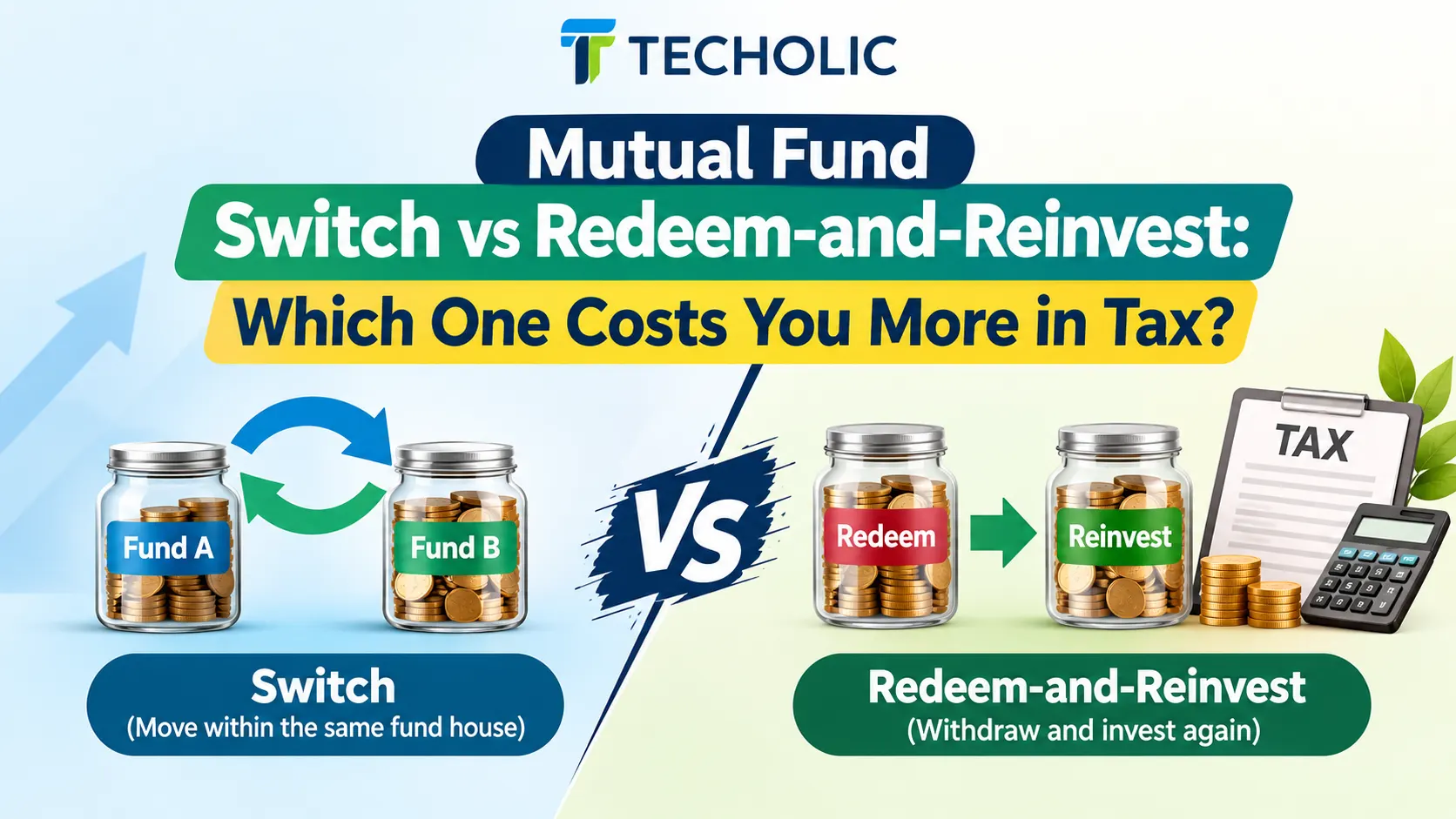
Every time you move money from one mutual fund to another, the Income Tax Department sees a sale. It doesn’t matter whether you clicked “Switch” on your app or manually redeemed and reinvested the proceeds — both actions close out your existing holding and open a new one, and both trigger capital gains tax on whatever you’ve earned so far. This is one of the most common gaps we see in investor understanding: people assume that because the money “stayed invested,” no tax event occurred. It did.
With equity mutual fund STCG now at 20% and LTCG at 12.5% above the ₹1.25 lakh annual exemption, the cost of getting this wrong isn’t small. If you’re rebalancing a portfolio, moving from an underperforming fund to a better one, or shifting from regular to direct plans, understanding exactly how a mutual fund switch is taxed — and how it compares to redeeming and reinvesting manually — can save you a meaningful amount every financial year.
This article breaks down both routes, what the tax department actually looks at, where the real differences lie, and how to make either move without giving away more than you need to.
What Exactly Happens When You Switch or Redeem a Mutual Fund?
Before comparing the tax impact, it helps to be clear on what each transaction technically involves — because the mechanics are where the real differences show up, not the tax rates.
What Does “Switching” Mean in Practice?
A switch is an internal transfer within the same Asset Management Company (AMC). When you switch from one scheme to another — say, from an equity fund to a debt fund, or from a regular plan to a direct plan — the fund house redeems your units in the source scheme at that day’s NAV and immediately uses the proceeds to allot units in the destination scheme, also at that day’s NAV. The money never touches your bank account.
Switching only works within the same fund house. If you want to move from an HDFC fund to a Parag Parikh fund, for instance, a switch isn’t possible — you’ll need to redeem from one and separately invest in the other.
What Does “Redeem and Reinvest” Actually Involve?
Redeeming means selling your units and having the proceeds credited to your registered bank account, typically within one to three working days for equity funds. Reinvesting is a separate, subsequent step — you then use that money to purchase units in a new scheme, which could be with any AMC.
This is the route you’re forced into whenever you’re moving across fund houses, and it’s also what many investors do out of habit even when a switch would have worked just as well within the same AMC.
Does the Income Tax Department Treat a Switch Differently From a Redemption?
No — and this is the single most important thing to understand before doing either. For tax purposes, a mutual fund switch is identical to a full redemption followed by a fresh purchase. The Income Tax Act treats the switch-out as a transfer of a capital asset, which means any gain on the units you’re exiting is taxable in that financial year, regardless of what you do with the proceeds afterward.
There is no provision that defers or exempts capital gains just because the money was redirected into another fund instead of your bank account. The switch-in, meanwhile, is simply treated as a new investment with a fresh acquisition date and a fresh holding-period clock — exactly as if you’d invested new money.
This surprises a lot of first-time switchers, and it’s a mistake we regularly help Techolic clients avoid before they act rather than after.
How Are STCG and LTCG Calculated on a Mutual Fund Switch?
The tax calculation depends entirely on what you’re switching out of — not what you’re switching into.
For equity-oriented funds (funds with more than 65% allocation to domestic equity):
- Units held for 12 months or less at the time of switch attract Short-Term Capital Gains (STCG) tax at a flat 20%
- Units held for more than 12 months attract Long-Term Capital Gains (LTCG) tax at 12.5%, applicable only on gains exceeding ₹1.25 lakh in aggregate for that financial year
- There is no indexation benefit available on these gains
For debt and specified mutual funds (units acquired on or after 1 April 2023, where the fund holds more than 65% in debt and money market instruments):
- All gains are taxed at your applicable income tax slab rate, regardless of how long you’ve held the units
- There is no long-term holding benefit at all for these funds under current rules
Here’s how this plays out in practice: suppose you invested ₹5 lakh in an equity fund and it’s now worth ₹7.5 lakh after 14 months. You decide to switch the entire amount into a different equity scheme. Your gain of ₹2.5 lakh qualifies as LTCG. After the ₹1.25 lakh exemption, ₹1.25 lakh is taxable at 12.5%, which comes to ₹15,625 in tax — payable in that financial year, even though every rupee went straight into your new fund and none of it reached your bank account.
If the same switch had happened at the 10-month mark instead, the entire ₹2.5 lakh gain would be STCG, taxed at 20% — a tax bill of ₹50,000, more than three times higher, purely because of timing.
Switch vs Redeem-and-Reinvest: Where Does the Real Cost Difference Come From?
Since the tax treatment is identical either way, the cost gap between switching and redeem-and-reinvest doesn’t come from tax rates. It comes from three other places.
Speed and market exposure. A switch is usually processed same-day if submitted before the cutoff time, meaning your money is out of one fund and into another within a single NAV cycle. Redeem-and-reinvest involves a gap — often one to three working days for the redemption to reflect in your bank account, plus however long you take to place the fresh investment. During that gap, your money isn’t earning anything and you’re exposed to the risk of missing a market move in either direction.
Paperwork and friction. A switch is a single request. Redeem-and-reinvest is two separate transactions, sometimes across two different platforms or AMC portals, with separate KYC and payment steps if you’re investing with a new fund house for the first time.
Exit load. This applies identically to both routes and depends entirely on the scheme you’re exiting, not the method you use. Most equity schemes charge around 1% exit load if you exit within 12 months; liquid funds often have a graduated exit load only within the first week; index funds and ETFs typically carry none. Always check the Scheme Information Document before switching or redeeming — the exit load schedule is the same whether you switch or manually redeem.
Where switch and redeem-and-reinvest are genuinely identical: the tax rate, the tax trigger point, the holding-period reset on the new investment, and the taxable gain calculation. None of these change based on which route you choose.
Can You Switch to Any Fund, or Only Within the Same AMC?
Only within the same AMC. This is a hard operational limit, not a tax rule. If your goal is to move from an equity fund at one fund house to a better-performing fund at a completely different fund house, a switch isn’t available to you — redeem-and-reinvest is your only option, and the tax outcome is exactly the same as it would be for an in-house switch.
This is worth planning around. If you’re comparing two similar funds and one happens to be with your existing AMC, the switch route saves you the redemption gap and the extra paperwork, without costing you anything extra in tax.
Common Mistakes Investors Make When Switching or Redeeming
- Assuming a switch avoids tax because the money didn’t leave the fund house. It doesn’t — the switch-out is a taxable transfer regardless of where the proceeds land.
- Switching just before the 12-month mark to “get it over with.” Waiting even a few weeks can move a gain from the 20% STCG bracket into the 12.5% LTCG bracket, and the ₹1.25 lakh exemption only applies to long-term gains.
- Not tracking cumulative LTCG across multiple redemptions in the same financial year. The ₹1.25 lakh exemption is an annual aggregate limit across all your equity fund and stock LTCG, not a per-transaction allowance. Investors who switch multiple funds through the year often blow past this limit without realising it.
- Treating debt fund switches like equity ones. Debt and specified mutual fund units bought after April 2023 are taxed at your slab rate no matter how long you’ve held them — there’s no reward for patience here, unlike equity.
- Chasing last year’s top-performing fund through frequent switching. Every switch resets your cost base and triggers a fresh tax event. Investors who switch two or three times a year to chase performance often find that STCG and exit loads together eat a large share of whatever extra return they were hoping to capture.
- Ignoring set-off opportunities. If you’re sitting on a loss in one fund, redeeming it in the same financial year as a gain elsewhere lets you offset the two, reducing your overall tax outgo. Many investors switch or redeem funds in isolation without looking at their full portfolio’s gains and losses for the year.
How Can You Rebalance or Switch Funds More Tax-Efficiently?
- Use your ₹1.25 lakh LTCG exemption every year. If you’re planning to exit a long-term holding eventually, consider doing it in tranches across financial years to make full use of the exemption each year rather than triggering the entire gain at once.
- Time your switch around the 12-month mark where feasible. If a fund you’re planning to exit is close to completing a year, waiting even a short period can shift the gain from 20% STCG to 12.5% LTCG.
- Harvest losses deliberately. If any part of your portfolio is underwater, redeeming it in the same year as a gain elsewhere can offset the tax bill, and you’re free to reinvest the proceeds right after (subject to any exit load).
- Prefer same-AMC switches when the alternative fund is comparable. You get identical tax treatment with less time out of the market and less paperwork.
- Track your SIP units separately. Redemptions and switches follow the FIFO (First-In-First-Out) method, meaning your oldest units are considered sold first. This affects whether a partial switch counts as short-term or long-term, so know your installment dates before you switch.
- Get your full-portfolio tax picture before acting. A switch that looks sensible for one fund can look very different once you account for gains and losses elsewhere in your portfolio for the same financial year. This is exactly where a structured review — the kind our advisory team at Techolic works through with clients — tends to catch costs that a fund-by-fund view misses.
Switch or Redeem — Which Should You Actually Choose?
Once you accept that the tax bill is identical either way, the decision stops being about tax and becomes purely operational:
- Choose switch when the destination fund is with the same AMC. It’s faster, involves one transaction instead of two, and keeps your money invested without a gap.
- Choose redeem-and-reinvest when you’re moving to a different fund house, when you actually need the money to pass through your bank account for any reason, or when you want a clean break before deciding where to reinvest.
- Either way, plan the timing. The holding period at the moment of exit — not the method of exit — is what determines whether you pay 20% or 12.5%, and whether your gain falls inside or outside the ₹1.25 lakh exemption.
The mistake to avoid isn’t picking the “wrong” method between switch and redeem-and-reinvest — it’s assuming either one lets you sidestep capital gains tax. Neither does. The real savings come from timing your exit, tracking your annual exemption, and offsetting losses where you have them, not from choosing one transaction type over the other.
Frequently Asked Questions
Is switching a mutual fund the same as selling it for tax purposes? Yes. A switch is treated as a redemption of the units you’re exiting and a fresh purchase in the new scheme. Capital gains tax applies on the units switched out, exactly as it would on a normal redemption.
Does switching within the same fund house avoid capital gains tax? No. Even switching between two schemes of the same AMC — including moving from a regular plan to a direct plan of the same fund — is treated as a taxable transfer because the two schemes have different ISINs and are legally separate investments.
How is tax calculated when I switch an equity mutual fund? If you’ve held the units for 12 months or less, the gain is taxed as STCG at 20%. If held for more than 12 months, it’s taxed as LTCG at 12.5% on gains above ₹1.25 lakh for that financial year, with no indexation benefit.
Is redeem-and-reinvest taxed differently from a direct switch? No. Both are treated identically by the Income Tax Department. The gain on the units you exit is taxable the same way regardless of whether the money passed through your bank account or moved directly into a new scheme.
Does exit load apply if I switch instead of redeeming? Yes, if the scheme you’re exiting has an exit load applicable at that holding period. The exit load schedule is set by the scheme itself and applies the same way whether you switch or redeem.
Can I switch between mutual funds of two different AMCs? No. A switch only works within the same fund house. To move your investment to a different AMC, you’ll need to redeem from the first fund and separately invest the proceeds in the new one — the tax treatment remains the same as an in-house switch.
Does the ₹1.25 lakh LTCG exemption apply separately to each fund I switch? No. It’s an aggregate annual limit across all your long-term equity mutual fund and listed share gains for the financial year, not a per-transaction or per-fund allowance.