Most investors build their mutual fund portfolio the way they fill a plate at a wedding buffet — a bit of whatever looks good that day. A large-cap fund because a colleague mentioned it, a small-cap fund because it topped last year’s return charts, an ELSS fund in March to save tax, and a debt fund because a bank RM suggested it. Five years later, they’re holding eleven schemes, most of them doing the same job, and none of them working together toward an actual goal.
A balanced mutual fund portfolio isn’t about owning a little of everything. It’s about deliberately mixing asset classes, fund categories, and risk levels so that the portfolio as a whole behaves the way you need it to — growing steadily, protecting you when markets fall, and staying aligned with how much time you actually have before you need the money. At Techolic, this is the single most common gap we see when we review client portfolios: plenty of good individual funds, but no coherent structure holding them together.
This blog walks through what “balanced” really means, how SEBI’s biggest re-categorisation in years changes the way you should think about fund selection, and how to build (and rebalance) a portfolio that does its job without becoming unmanageable.
What Does “Balanced” Actually Mean in a Mutual Fund Portfolio?
Balance doesn’t mean equal weight across everything, and it doesn’t mean owning a “balanced fund” (a hybrid category) and calling it done. A genuinely balanced mutual fund portfolio has three things working in sync:
- Asset allocation that matches your risk capacity and time horizon — how much sits in equity versus debt versus other assets like gold
- Diversification without duplication — enough spread to reduce single-stock or single-sector risk, without holding five funds that quietly own the same 40 stocks
- A structure that maps to your goals — money you need in 2 years shouldn’t sit in the same bucket as money you need in 20
Miss any one of these and the portfolio stops being balanced, even if it looks diversified on paper. We’ve reviewed portfolios with twelve mutual funds that had less real diversification than a two-fund portfolio, simply because every scheme was a large-cap-heavy multi-cap fund wearing a different name.
How Has SEBI’s 2026 Re-Categorisation Changed Portfolio Building?
If you’re building or rebalancing a portfolio in 2026, this matters more than most articles are giving it credit for. SEBI issued a fresh circular on 26 February 2026 that reworked the categorisation and rationalisation framework for mutual fund schemes — the first major overhaul since 2017 — and it changes how a balanced mutual fund portfolio should be constructed.
A few changes are directly relevant to you as an investor:
- Life Cycle Funds are now a formal category. These are open-ended schemes with a stated target maturity date, running anywhere from 5 to 30 years, that automatically shift from equity-heavy to debt-heavy as the target date approaches – essentially a built-in glide path. For someone who doesn’t want to actively rebalance every year, a Life Cycle Fund does a chunk of that work for you.
- Children’s and retirement solution-oriented funds are being phased out. Existing investors stay invested, but no new money is being accepted into these schemes going forward. If your “balanced portfolio” currently leans on one of these for a specific goal, it’s worth reviewing what it eventually merges into.
- Portfolio overlap is capped and disclosed monthly. SEBI has limited overlap between certain equity schemes (value, contra, thematic) to 50%, and fund houses must now disclose overlap data every month. This is a genuinely useful tool -s if two of your funds show high overlap, one of them isn’t adding diversification, it’s adding cost.
- Hybrid funds get more flexibility. The non-core portion of equity and hybrid schemes can now include gold ETFs, silver ETFs, InvITs, and specific debt instruments, giving fund managers (and by extension, your portfolio) more genuine diversification tools than before.
The practical takeaway: before you add a fifth or sixth fund to your portfolio in the name of balance, check its category definition and overlap disclosure. SEBI has made this data more accessible than ever – use it.
What Are the Core Asset Classes You Need to Balance?
A balanced mutual fund portfolio typically draws from three to four building blocks:
- Equity funds — large-cap, flexi-cap, mid-cap, small-cap, and sectoral/thematic schemes. Highest long-term growth potential, highest short-term volatility. Historically delivered strong double-digit CAGR over 10+ year periods, with annual swings that can easily run ±25-30% in either direction.
- Debt funds — liquid, ultra-short duration, corporate bond, banking & PSU, gilt, and dynamic bond funds. Lower volatility, income-oriented, useful for capital protection and short-term goals.
- Hybrid funds — conservative, balanced, and aggressive hybrid schemes that mix equity and debt in fixed proportions, plus multi-asset funds that add gold or commodities into the mix.
- Gold and international funds — smaller allocations (typically 5-10%) that behave differently from Indian equity and debt, adding a genuine diversification layer during periods when domestic markets underperform.
A common mistake is treating “equity” as one bucket. A large-cap fund and a small-cap fund behave very differently during a correction — the small-cap fund can fall twice as hard. Balance within equity matters just as much as balance between equity and debt.
How Should You Decide Your Equity-Debt Ratio?
This is where most generic advice fails Indian investors — “100 minus your age” is a starting point, not a rule. Your equity-debt split should really be driven by three questions:
- When do you need this money? Goals more than 7 years away can absorb higher equity exposure because there’s time to ride out volatility. Goals under 3 years should lean heavily debt, regardless of your age or risk appetite.
- How would you actually react to a 20% fall? Risk capacity (what your finances can handle) and risk tolerance (what your temperament can handle) are different things. A 30-year-old with a stable government job and a 30-year-old freelancer with irregular income have different risk capacity even at the same age.
- What else do you already hold? If you have EPF, PPF, or a paid-up insurance-cum-investment policy, those are effectively debt allocations sitting outside your mutual fund portfolio. A balanced mutual fund portfolio should account for what you hold elsewhere, not just what’s inside the folio.
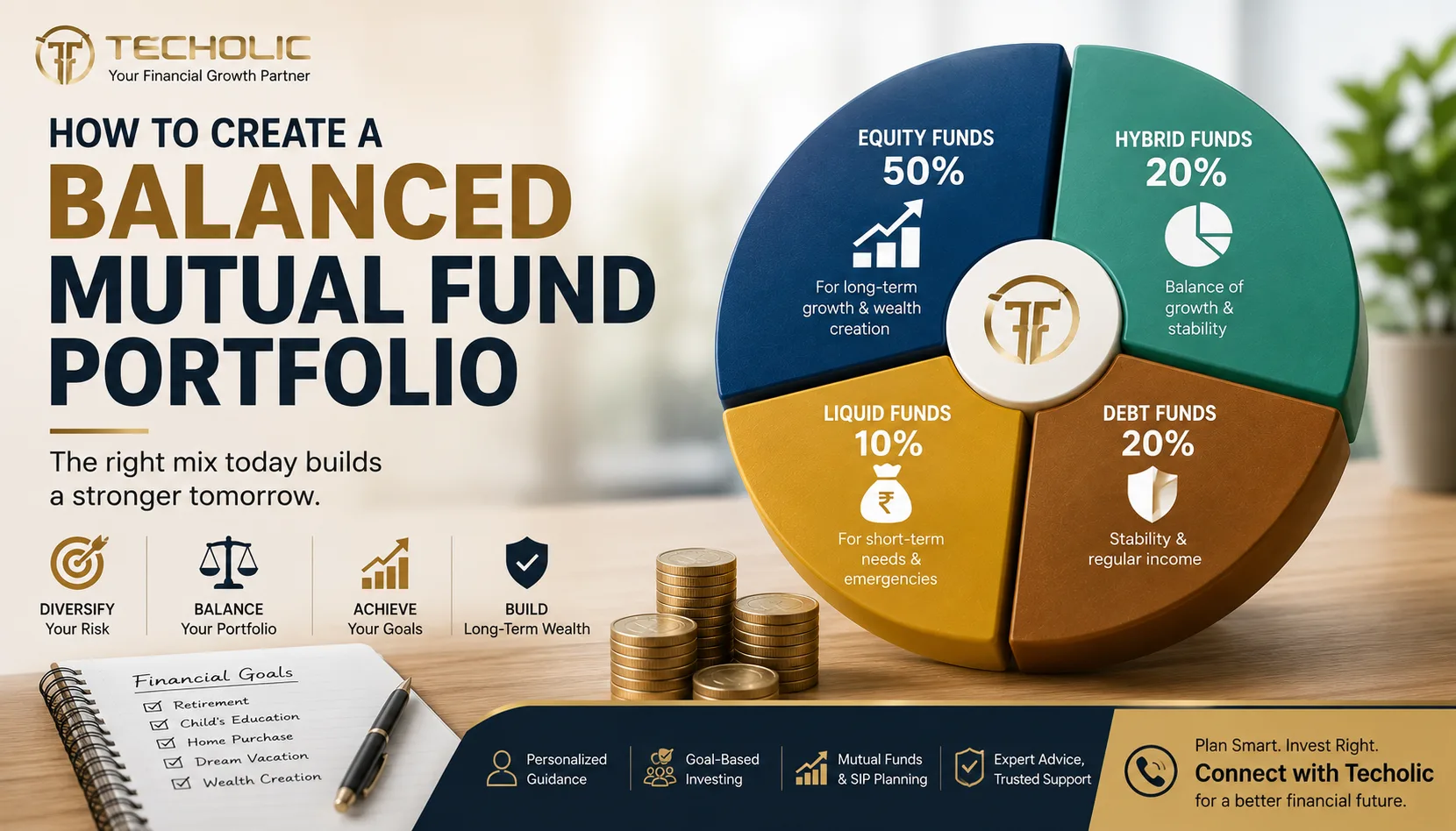
As a working framework, many advisors at Techolic suggest starting with a horizon-based split — roughly 70-80% equity for goals 10+ years away, 50-60% equity for 5-7 year goals, and 20-30% equity for under-3-year goals — then adjusting up or down based on the two questions above.
How Many Mutual Funds Are Enough for a Balanced Portfolio?
More funds does not mean more balance. Past a certain point, adding funds just adds overlap, complexity, and higher aggregate expense ratio without meaningfully reducing risk. For most individual investors, 4 to 7 well-chosen funds across categories can build a genuinely balanced mutual fund portfolio:
- One large-cap or flexi-cap fund as the core holding
- One mid-cap or small-cap fund for growth (sized to your risk tolerance)
- One debt fund matched to your shorter-term goals
- One hybrid or multi-asset fund for a smoother ride
- Optionally, one gold or international fund for genuine diversification
- An ELSS fund if you’re still using the Section 80C route
If you already own ten or more funds, the exercise isn’t to add an eleventh — it’s to map what you have against SEBI’s monthly overlap disclosures and consolidate.
How Should a Balanced Portfolio Look at Different Life Stages?
In your 20s and early 30s, with long goals: Equity can dominate — 75-85% in a mix of flexi-cap and mid-cap funds, with a small debt allocation purely for the emergency fund and near-term needs. Time is your biggest asset here.
In your late 30s to 40s, juggling multiple goals: This is usually when portfolios get messy because goals overlap — a child’s education in 8 years, a house in 3 years, retirement in 20. A balanced mutual fund portfolio at this stage often benefits from goal-tagging: separate SIPs mapped to each goal’s horizon, rather than one undifferentiated pile of funds. Aggressive hybrid or Life Cycle Funds work well for the medium-term goals here.
Approaching retirement, 5-10 years out: Equity allocation should be tapering down deliberately, not accidentally. Conservative hybrid funds, debt funds with shorter duration, and a reduced small-cap exposure protect the corpus you’ve built from a bad sequence-of-returns year right before you need the money.
In retirement: Balance shifts toward capital preservation and income — conservative hybrid funds, SWPs (systematic withdrawal plans) from equity funds for tax-efficient income, and enough debt to cover 2-3 years of expenses so you’re never forced to sell equity in a down market.
What Role Do Hybrid and Life Cycle Funds Play in a Balanced Portfolio?
Hybrid funds exist specifically to do part of the balancing work for you. A conservative hybrid fund (10-25% equity, rest debt) suits someone who wants income with a small growth kicker. An aggressive hybrid fund (65-80% equity) suits someone who wants equity-like tax treatment with somewhat lower volatility than a pure equity fund. Multi-asset funds go a step further, blending equity, debt, and gold or commodities in one scheme.
Life Cycle Funds, newly formalised under SEBI’s 2026 framework, are worth serious consideration if you find rebalancing tedious or tend to react emotionally to market swings. You pick a target date matching your goal, and the fund manager handles the equity-to-debt glide path for you. The trade-off is less personalisation — the glide path is designed for the average investor with that horizon, not your specific risk profile.
Neither hybrid nor Life Cycle Funds should be your only holding in a balanced mutual fund portfolio, but as one component among several, they reduce the manual work of maintaining balance over time.
How Does Taxation Affect a Balanced Mutual Fund Portfolio?
Balance isn’t just about returns and risk — post-tax returns are what actually reach your goal, so taxation should influence how you structure and rebalance.
- Equity funds (65%+ in domestic equity): gains held under 12 months are taxed as STCG at 20%; gains held over 12 months are taxed as LTCG at 12.5% on profits above ₹1.25 lakh in a financial year, with no indexation benefit.
- Debt funds purchased on or after 1 April 2023 are taxed at your income slab rate regardless of how long you hold them — there’s no separate LTCG benefit anymore for these units.
- Hybrid funds are taxed as equity or debt depending on their actual equity allocation, so two hybrid funds with different equity exposure can carry very different tax treatment.
- Gold and international funds now fall outside the old indexation-linked regime and are taxed at 12.5% LTCG after the applicable long-term threshold, without the ₹1.25 lakh exemption that equity funds get.
This is one more reason not to churn a balanced mutual fund portfolio unnecessarily. Frequent switching between categories to “rebalance” can quietly erode returns through STCG and slab-rate taxation on the debt portion — annual or semi-annual rebalancing, done deliberately, usually beats frequent tinkering.
What Are the Most Common Mistakes Investors Make When Trying to Build Balance?
- Confusing “hybrid fund” with “balanced portfolio.” Owning one balanced/hybrid fund doesn’t mean your overall portfolio is balanced, especially if you hold other equity-heavy funds alongside it.
- Chasing last year’s top performer. The best-performing category rotates constantly; a balanced mutual fund portfolio is built on allocation logic, not on chasing whichever fund topped the charts last year.
- Ignoring overlap. Multiple flexi-cap or large-cap funds from different AMCs often hold largely the same top stocks. SEBI’s monthly overlap disclosures make this easy to check now — most investors simply never look.
- Treating debt allocation as an afterthought. Debt isn’t just “the boring part” — it’s what lets you avoid selling equity at a loss when you need money urgently.
- Never rebalancing. A portfolio that was 70:30 equity-debt three years ago might now be 85:15 purely because equity markets ran up. Without periodic rebalancing, your risk level drifts without you noticing.
- Over-diversifying into complexity. Fifteen funds are harder to track, harder to rebalance, and rarely reduce risk meaningfully beyond what 6-7 well-chosen funds already achieve.
How Often Should You Rebalance a Balanced Mutual Fund Portfolio?
Once or twice a year is usually enough for most investors — quarterly reviews if markets have been especially volatile. Rebalancing means bringing your equity-debt (and within-equity) allocation back to your target ratio, not overhauling your fund selection. If your target is 70:30 and market movement has pushed you to 78:22, moving that 8% back into debt restores your intended risk level.
A practical trigger many investors at Techolic find useful: rebalance when any asset class drifts more than 5-7 percentage points from its target weight, rather than rebalancing on a rigid calendar regardless of how far things have moved. This keeps you disciplined without triggering unnecessary transactions (and unnecessary tax) over minor fluctuations.
Frequently Asked Questions
Is a hybrid mutual fund the same as a balanced mutual fund portfolio? No. A hybrid fund is one scheme that mixes equity and debt internally. A balanced mutual fund portfolio is your entire collection of holdings working together toward your goals — it may or may not include a hybrid fund as one component.
How many mutual funds should I hold for proper balance? Most individual investors don’t need more than 4-7 funds across categories. Beyond that, additional funds usually add overlap and complexity rather than genuine diversification.
Should I include gold in my balanced mutual fund portfolio? A small allocation, typically 5-10%, can help because gold often moves differently from equity and debt during market stress. It shouldn’t dominate the portfolio, but as a diversifier it earns its place.
Do Life Cycle Funds remove the need to rebalance manually? Largely, yes, for the goal that specific fund is mapped to. The fund’s own glide path handles the equity-to-debt shift automatically. You’d still need to manage balance across your other goals and holdings separately.
Is SIP or lump sum better for building a balanced portfolio? For most salaried and self-employed Indian investors, SIPs make more sense because they enforce discipline and average out purchase cost over time. Lump sum can work for debt allocations or when markets have corrected meaningfully, but SIP remains the more practical default for equity.
How does SEBI’s 2026 re-categorisation affect my existing portfolio? If you hold solution-oriented (children’s or retirement) funds, check what they’re merging into, since no new investments are being accepted into these schemes. Otherwise, use the new monthly portfolio overlap disclosures to check whether your existing funds genuinely diversify each other.