
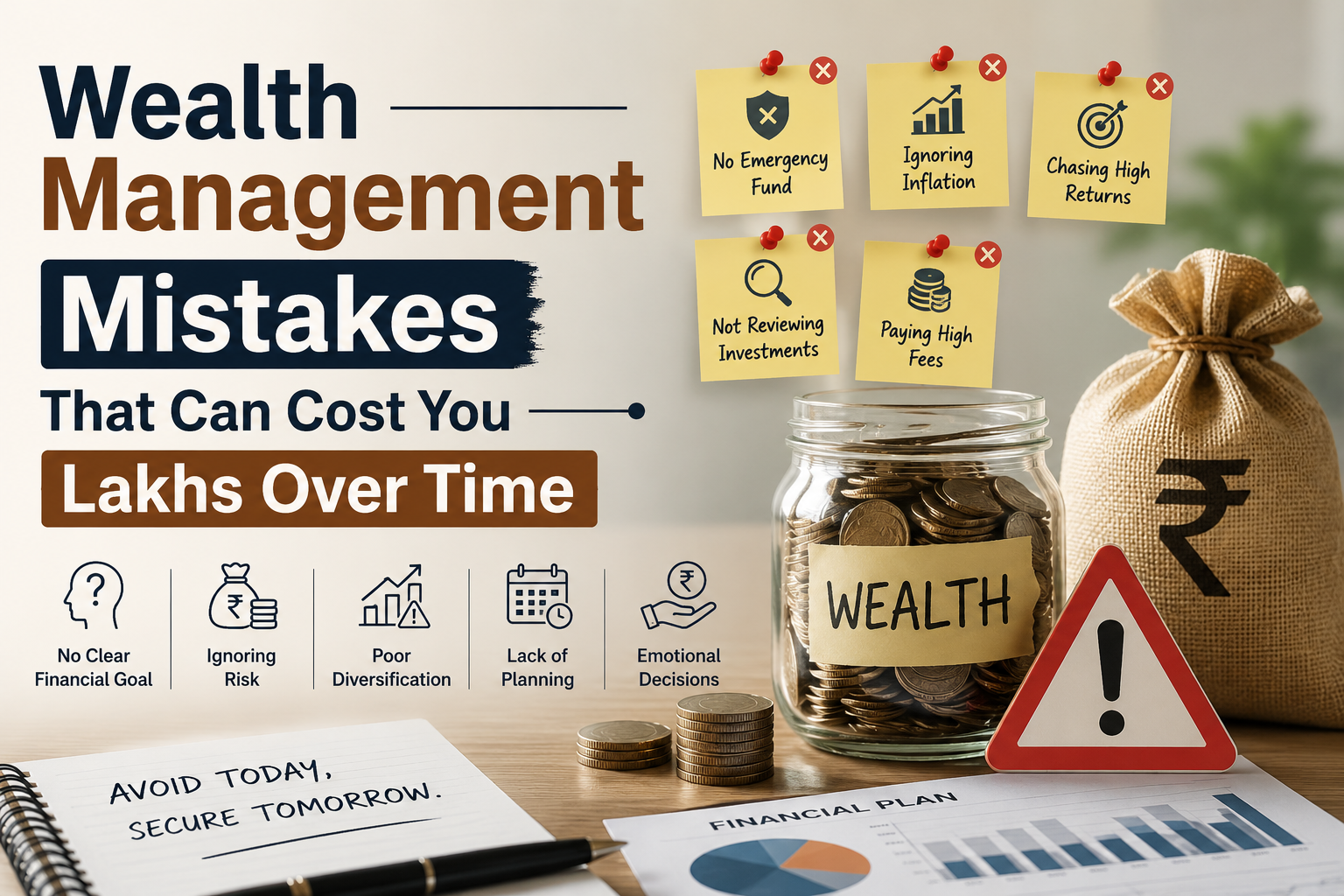
Studies tracking Indian mutual fund investors over the long term have repeatedly found the same pattern: the average investor earns meaningfully less than the very funds they’re invested in — sometimes 3-5% less annually. The fund did its job. The investor’s own decisions around it — when they entered, when they panicked, when they stopped their SIP — ate the difference. Compounded over 20 years, that gap is where lakhs quietly disappear. It’s rarely one big mistake. It’s a handful of small, repeatable ones.
At Techolic, we’ve reviewed hundreds of portfolios from investors across metros and smaller cities, and this behavior gap shows up almost every time, wearing different disguises. Today we walk you through the wealth management mistakes that do the most damage, why they happen, and what a more deliberate approach looks like.
What Are the Most Common Wealth Management Mistakes Indian Investors Make?
Before getting into specifics, it helps to see the full list at once, because these mistakes rarely occur in isolation — they compound each other.
- Building a portfolio without a written asset allocation plan
- Chasing last year’s top-performing fund or stock
- Ignoring tax efficiency until the capital gains bill arrives
- Investing without an emergency fund as a buffer
- Delaying the first investment by years while “researching”
- Confusing diversification with owning dozens of similar funds
- Treating insurance as an investment product instead of protection
- Letting fear or greed drive entry and exit decisions
- Never rebalancing once the initial portfolio is set up
Each of these looks minor in isolation. Together, over a 15–20 year investing horizon, they are the difference between a portfolio that comfortably funds retirement and one that falls short by a significant margin.
Why Does Ignoring Asset Allocation Cost You So Much Over Time?
Asset allocation — how you split money across equity, debt, gold, and cash — determines roughly 80-90% of your long-term portfolio outcome, far more than fund selection or market timing. Yet most investors build their portfolio the opposite way: they pick individual funds or stocks first, based on recent performance, and only think about allocation as an afterthought, if at all.
Consider two investors, both 30 years old, each investing ₹15,000 a month.
Investor A builds a written plan: 70% equity, 20% debt, 10% gold, rebalanced annually.
Investor B invests the same amount but shifts between whatever asset class is trending — heavy equity in a bull run, heavy debt after a correction scares them.
Investor A’s discipline means they buy more equity when it’s cheap and trim it when it’s expensive, almost mechanically. Investor B tends to do the opposite — buying euphoria and selling panic. Over two decades, this behavioral gap alone can easily account for a 2-3% difference in annualised returns, which on a long SIP translates into lakhs of difference in the final corpus.
How Does Chasing Past Returns Destroy Wealth?
“This fund gave 35% last year” is one of the most expensive sentences in Indian investing. Past performance, especially over a one- or two-year window, is a poor predictor of future returns and is frequently the result of a sector rally, a small-cap cycle, or a fund manager taking concentrated bets that may not repeat.
Here’s what typically happens: an investor sees a chart-topping fund, invests a lump sum near the peak of its cycle, the category cools off or mean-reverts, and the investor exits at a loss a year or two later — often right before the next up-cycle begins. This buy-high-sell-low pattern, repeated across a few funds over a decade, is one of the biggest wealth management mistakes we see in real portfolios.
A more reliable filter looks at:
- Consistency of returns across multiple market cycles (5-7 years minimum), not just the last 12 months
- The fund’s performance relative to its category during downturns, not just rallies
- Expense ratio and portfolio turnover, which quietly eat into returns every single year
- Whether the fund’s mandate and risk level actually match your own goals
Is Skipping Tax Planning Silently Eating Your Returns?
Tax isn’t a year-end afterthought — it’s a return-reducing cost that compounds just like fees do. Under current rules, long-term capital gains on equity mutual funds and listed shares above ₹1.25 lakh in a financial year are taxed at 12.5%, while short-term gains (holding period under 12 months) are taxed at a flat 20%. Debt fund gains, for units bought after April 2023, are taxed at your income slab rate regardless of how long you hold them.
Investors who ignore this structure make three recurring errors:
Redeeming units impulsively without checking the holding period — converting what would have been a lower-taxed long-term gain into a higher short-term tax bill.
Never using the ₹1.25 lakh annual LTCG exemption — it resets every financial year and is lost if unused, a form of tax-loss harvesting many investors simply don’t do.
Holding debt funds for “safety” without realising post-2023 taxation makes them far less efficient for investors in higher tax slabs, depending on the individual’s situation and goals.
A wealth management approach that factors in taxation at the point of investment — not just at the point of exit — routinely adds a meaningfully higher post-tax return over a decade, without taking on any additional market risk.
Why Do Investors Without an Emergency Fund End Up Breaking Their Investments?
This is one of the quieter wealth management mistakes because it doesn’t look like an investing mistake at all — it looks like a medical emergency, a job loss, or a large unplanned expense. But the damage shows up in the portfolio.
Without 6-9 months of expenses set aside in a liquid instrument, investors are forced to redeem long-term investments — often equity mutual funds or stocks — at whatever price the market happens to be offering that month. If that month coincides with a downturn, the investor locks in a loss and also loses the years of compounding that redeemed money would have generated. We’ve seen SIPs that were running consistently for six years get interrupted for exactly this reason, and the investor never restarts the habit at the same intensity.
The fix is straightforward and doesn’t require sophisticated planning: build the emergency fund in a sweep-in fixed deposit or a liquid fund before scaling up equity exposure, not after.
How Much Does Delaying Investments Actually Cost You?
Time in the market matters more than almost any other single factor, because compounding is exponential, not linear — most of the growth happens in the later years, and delaying the start pushes those high-growth years out of reach entirely.
Take two investors, both investing ₹10,000 a month at an assumed 12% annual return until age 55:
Investor A starts at 25. By 55, the invested amount is ₹36 lakh, and the corpus grows to roughly ₹3.5 crore.
Investor B starts at 35, ten years later, investing the same ₹10,000 a month. The invested amount is ₹24 lakh, but the corpus reaches only around ₹1 crore.
A ten-year delay doesn’t cost ten years of contributions — it costs roughly ₹2.5 crore in final corpus, because those first ten years were exactly the ones where compounding had the most runway to work. This single mistake, waiting for the “right time” to start, is arguably the costliest of all wealth management mistakes, because unlike a bad fund choice, it can never be corrected later — you simply cannot buy back lost time.
Are You Over-Diversifying or Under-Diversifying Your Portfolio?
Both extremes are common, and both are expensive in different ways.
Under-diversification looks like an investor holding 90% of their net worth in employer stock, or in a single sector like IT or banking, because that’s what they understand best. A downturn in that one sector then disproportionately damages the entire portfolio.
Over-diversification looks like an investor holding 15-18 mutual fund schemes, many of which sit in the same category (multiple large-cap funds, for instance) and effectively track the same index with different names. This doesn’t reduce risk meaningfully — it just adds complexity, overlapping holdings, and makes the portfolio harder to track, rebalance, or exit efficiently.
A practically diversified portfolio for most investors typically includes:
- 3-5 mutual fund schemes across genuinely different categories (large-cap, flexi-cap, mid/small-cap, debt, and possibly international or gold)
- No single stock or sector exceeding a defined ceiling of overall net worth
- Clear separation between long-term wealth creation money and short-term goal-based money
Why Does Ignoring Insurance as Part of Wealth Management Backfire?
Insurance and investment are two different jobs, and combining them into one product is one of the most persistent wealth management mistakes in the Indian market. Traditional endowment and money-back policies are frequently sold as “investment plans,” but the actual returns after all charges typically land in the 4-6% range — well below what a straightforward term plan plus mutual fund combination can achieve.
The bigger risk, though, isn’t under performance – it’s under insurance. A family’s sole earning member without adequate term cover, or a household without health insurance beyond a basic employer policy, is one hospitalization or one unfortunate event away from having to liquidate investments that took a decade to build. Protection isn’t the exciting part of wealth management, but skipping it undermines every other decision made correctly.
What Role Does Emotional Investing Play in Wealth Erosion?
Markets are volatile by design — that volatility is precisely why equity delivers higher long-term returns than fixed deposits. Investors who can’t tolerate that volatility end up making decisions at exactly the wrong moments: panic-selling during a correction and buying back in only after the market has already recovered, having paid the emotional and financial cost of both moves.
Common patterns we’ve observed:
- Stopping SIPs during a market fall, which is precisely when unit purchase costs are lowest
- Checking portfolio value daily or weekly, which magnifies short-term noise and triggers impulsive decisions
- Making large lump-sum decisions based on news headlines rather than a written financial plan
A written investment policy — even a simple one-page document stating your goals, target allocation, and rebalancing rules — removes most of this emotional decision-making, because the plan was made when you were calm, not when the market was moving.
How Can You Avoid These Wealth Management Mistakes Going Forward?
Fixing this doesn’t require a dramatic overhaul. It requires a small number of structural changes, applied consistently:
- Write down your asset allocation before choosing individual funds or stocks, and rebalance it once a year, not based on market mood
- Build your emergency fund first, then scale up equity exposure with confidence
- Check tax implications before every redemption, not after, and use the annual LTCG exemption deliberately
- Separate insurance from investment — buy adequate term and health cover independently of any investment product
- Automate your SIPs and avoid checking your portfolio more than once a quarter, to reduce emotionally driven decisions
- Review, don’t chase — evaluate funds on 5-7 year consistency, not last year’s chart-topper
At Techolic, this is the core of how we think about wealth management for our clients — not chasing the highest possible return in any given year, but structurally removing the mistakes that erode returns over a decade or more. The math of compounding rewards consistency far more than it rewards brilliance in any single year.
Frequently Asked Questions
What is the single biggest wealth management mistake Indian investors make?
Delaying the start of investing while waiting for the “right time” is generally the costliest, because compounding is time-dependent and lost early years can never be recovered later, regardless of how much is invested afterward.
How much can wealth management mistakes actually cost over 20-30 years?
Depending on the combination of mistakes — delayed starts, poor tax planning, panic-driven exits, and misallocated assets — the difference between a disciplined and an undisciplined approach can easily run into several lakhs to crores on an identical monthly investment amount, purely due to behavioural and structural differences.
Is it a mistake to invest without a financial advisor?
Not necessarily, but going in without any written plan, allocation strategy, or tax awareness increases the odds of the common mistakes covered above. Some investors manage this well independently; others benefit from structured guidance, particularly as portfolios grow more complex.
How often should I review my portfolio to avoid these mistakes?
A quarterly or half-yearly review is usually enough for most long-term investors. Reviewing more frequently than that tends to increase emotional decision-making rather than improve outcomes.
Does tax-loss harvesting actually make a meaningful difference?
Yes. Using the ₹1.25 lakh annual LTCG exemption every financial year, rather than letting it lapse unused, can meaningfully reduce the tax drag on a long-term equity portfolio when done consistently over many years.
What’s a practical first step if I recognize several of these mistakes in my own portfolio?
Start with a written asset allocation plan and an emergency fund if you don’t already have one — these two changes alone address the root cause of most of the other mistakes on this list.