
A health insurance claim getting rejected right when you need the money most is one of the most stressful experiences a policyholder can face. It’s also more common than most people realise — IRDAI’s own data shows roughly one in every twelve health insurance claims in India gets rejected, and thousands of crores worth of claims get disallowed every year. At Techolic, we’ve seen the same handful of reasons come up again and again when clients bring us a rejected claim, and almost all of them are avoidable if you know what to watch for before you’re lying in a hospital bed.
This article breaks down exactly why health insurance claims get rejected in India, what IRDAI’s rules actually protect you against, and the practical steps that prevent most rejections from happening in the first place.
Why Do Health Insurance Claims Actually Get Rejected in India?
Most rejections aren’t random or arbitrary — they cluster around a small set of recurring patterns tied to specific policy clauses. Understanding these patterns is the first step to protecting yourself.
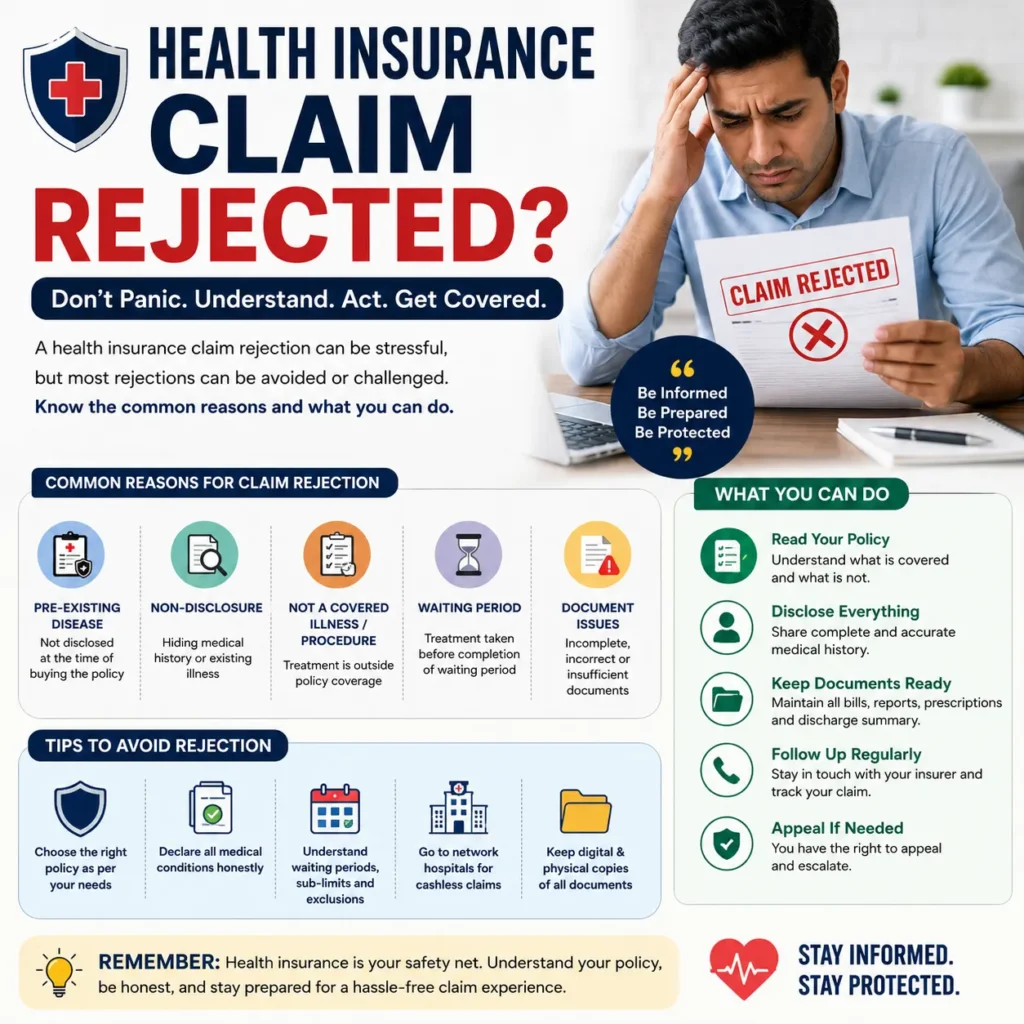
Non-disclosure of pre-existing conditions. This remains the single most common reason for rejection. If you had a health condition — diabetes, hypertension, thyroid issues, or even something you considered minor — and didn’t declare it clearly on your proposal form, the insurer has a legal basis to reject a related claim, and sometimes the entire policy.
An active waiting period. Most health policies carry an initial waiting period of about 30 days for illnesses (though accidents are usually covered from day one), a separate 2 to 4-year waiting period for pre-existing diseases, and specific waiting periods for conditions like cataract surgery, hernia, or joint replacement. A claim filed during any of these active waiting windows will typically be rejected, even if your policy is otherwise in good standing.
Room rent and sub-limit caps. Many policies cap the room rent they’ll cover, and if you choose a room above that limit, the insurer doesn’t just deny the difference — it often applies a proportionate deduction across your entire bill, including doctor’s fees and procedure costs, not just the room charge itself. This single clause causes far more partial rejections than people expect.
Documentation errors. A surprisingly large share of reimbursement claim rejections trace back to something as basic as an illegible or incomplete discharge summary from the hospital, missing itemized bills, or mismatched patient details across documents. This is also the most fixable reason on this list.
Non-medical and excluded expenses. Items like consumables, administrative charges, and certain medications or procedures explicitly excluded in your policy wording get deducted from claim payouts, which can make a settled claim feel like a rejection when it’s actually a partial payout.
Treatment outside policy terms. Claims for conditions or treatments specifically excluded in your policy – cosmetic procedures, certain alternative treatments, or conditions outside your defined coverage – will be rejected regardless of how genuine the medical need is, simply because they fall outside what you’re covered for.
What Protections Does IRDAI Actually Give You as a Policyholder?
This is the part most policyholders don’t know exists, and it works strongly in your favor if you understand it.
The 5-year moratorium period. Once you’ve held a health policy continuously, without a break, for five years, the insurer cannot reject a claim on the grounds of non-disclosure or misrepresentation, except in cases of proven fraud or claims that fall under a permanent exclusion clearly stated in your policy. This moratorium only protects you if your original disclosure was honest, not deliberately concealed.
Cashless treatment at any hospital. Under the Cashless Everywhere initiative, you’re entitled to cashless treatment even at a hospital outside your insurer’s network, not just at listed network hospitals. Insurers are required to give an initial cashless pre-authorization quickly and a final authorization at the time of discharge, so you’re not stuck arranging a lump-sum payment while a family member waits to be discharged.
A defined claim settlement timeline. IRDAI requires insurers to settle genuine claims within a fixed window after receiving your final discharge summary and complete documentation. If an insurer misses this deadline without valid reason, the claim can be treated as approved, with penal interest applying on the delayed payout.
Capped premium hikes for senior citizens. For policyholders aged 60 and above, insurers cannot increase annual premiums beyond a defined limit without prior IRDAI approval, which protects older policyholders from sudden, steep premium jumps that might otherwise push them to drop coverage.
Portability without losing your waiting period credit. If you’re unhappy with your current insurer, you can port to a new one without restarting your waiting periods from zero, as long as you initiate the portability request well before your renewal date — typically at least 45 days in advance.
How Can You Actually Avoid a Claim Rejection Before It Happens?
Most of what causes rejections can be prevented with a few deliberate habits at the time of purchase and during hospitalization:
- Disclose your complete medical history honestly at the time of buying the policy, even conditions that feel minor or unrelated — insurers verify this against hospital records later, and an omission discovered during a claim is far more costly than a slightly higher premium upfront
- Read your policy’s waiting period schedule carefully before assuming a condition is covered, especially for planned surgeries like cataract or joint replacement that often carry specific waiting periods separate from the general pre-existing disease clause
- Check your room rent sub-limit before choosing a hospital room category, since exceeding it doesn’t just cost you the room rent difference — it can proportionately reduce your entire claim payout
- Keep every document organized during hospitalization — discharge summary, itemized final bill, diagnostic reports, and doctor’s prescriptions — since documentation gaps remain one of the most common and entirely avoidable reasons claims get delayed or rejected
- Inform your insurer promptly once hospitalization occurs, even if you’re not yet ready to file the full claim, since delayed intimation without any genuine reason can still complicate the process even though IRDAI rules state that reasonable delay alone cannot be the sole ground for rejection
- Understand what your policy explicitly excludes before you need to use it, so you’re not caught off guard by a treatment or condition that was never part of your coverage in the first place
What Should You Do If Your Health Insurance Claim Gets Rejected?
A rejection isn’t necessarily final, and IRDAI has built a structured escalation path specifically because many rejections get reversed once a policyholder pushes back correctly.
- Get the rejection reason in writing, along with the exact policy clause the insurer is citing. A verbal explanation over the phone has no standing if you need to dispute the decision later
- Approach your insurer’s Grievance Redressal Officer first, since a large share of disputed rejections get resolved at this stage once documentation gaps are addressed or a clause is reviewed more carefully
- Use the Bima Bharosa portal if your insurer’s internal grievance process doesn’t resolve the issue satisfactorily — this is IRDAI’s dedicated channel for policyholder complaints
- File with the Insurance Ombudsman if the matter remains unresolved. This is a free, faster alternative to court for claims within a defined limit, and the Ombudsman’s award is binding on the insurer
- Keep a complete paper trail of every communication, bill, and document from the point of hospitalization onward, since a well-documented case is significantly harder for an insurer to dispute at any stage of escalation
Common Mistakes Policyholders Make That Lead to Rejections
- Assuming a condition is “minor enough” to skip disclosing. Insurers cross-check disclosures against hospital records during a claim, and even a small omission can be treated as misrepresentation
- Not checking waiting periods before scheduling planned treatment. Elective procedures like cataract surgery or hernia repair often have specific waiting periods that catch policyholders off guard
- Choosing a hospital room without checking the sub-limit first. This single oversight causes proportionate deductions across the entire bill, not just the room charge
- Losing or misplacing original bills and reports. Reimbursement claims in particular depend heavily on complete, legible documentation
- Letting the policy lapse even briefly. A break in continuity resets your waiting periods and moratorium clock, undoing years of continuous coverage in one missed renewal
Frequently Asked Questions
What is the most common reason health insurance claims get rejected in India?
Non-disclosure of pre-existing medical conditions at the time of buying the policy remains the single most common reason, followed closely by claims filed during an active waiting period and documentation errors like incomplete or illegible discharge summaries.
Can an insurer reject my claim after I’ve held the policy for many years?
After five years of continuous, unbroken coverage, insurers generally cannot reject a claim on grounds of non-disclosure or misrepresentation, except in cases of proven fraud or claims falling under a clearly stated permanent exclusion in your policy.
Why did my hospital bill get only partially paid instead of fully rejected?
This usually happens due to room rent sub-limits, non-medical or excluded expense deductions, or proportionate deduction clauses, where exceeding one part of your policy’s limits reduces the payout across related expenses rather than rejecting the entire claim.
Does delaying claim intimation automatically lead to rejection?
Not on its own. IRDAI rules state that a genuine, reasonable delay in informing the insurer cannot be the sole ground for rejecting an otherwise valid claim, though prompt intimation still makes the overall process smoother.
What can I do if my health insurance claim is rejected unfairly?
Start by getting the rejection reason in writing, then approach your insurer’s Grievance Redressal Officer, escalate to the Bima Bharosa portal if unresolved, and finally file a complaint with the Insurance Ombudsman, which offers free, binding resolution for eligible claims.
Does switching insurers reset my waiting period?
No, as long as you port to a new insurer correctly, ideally at least 45 days before your policy renewal date, your accumulated waiting period credit carries over instead of restarting from scratch.