In December 2018, the promoters of Zee Entertainment held about 42% of the company. By late 2019 that stake was down to roughly 5%. The channels were still on air and the advertising still came in. What changed was the promoter group’s balance sheet. A sharp fall in the share price in January 2019 led lenders to sell some pledged shares, and the group later sold a 16.5% stake in a block deal to repay what it owed.
That is the risk hiding behind promoter pledging. It does not appear in a company’s profit and loss account or in the management’s investor presentation, yet it can decide how hard a stock falls when the market turns. In this guide we explain how pledging works, how to check it for any listed company, and how we read the numbers at Techolic before a mid-cap or small-cap stock earns a place on a client’s watchlist.
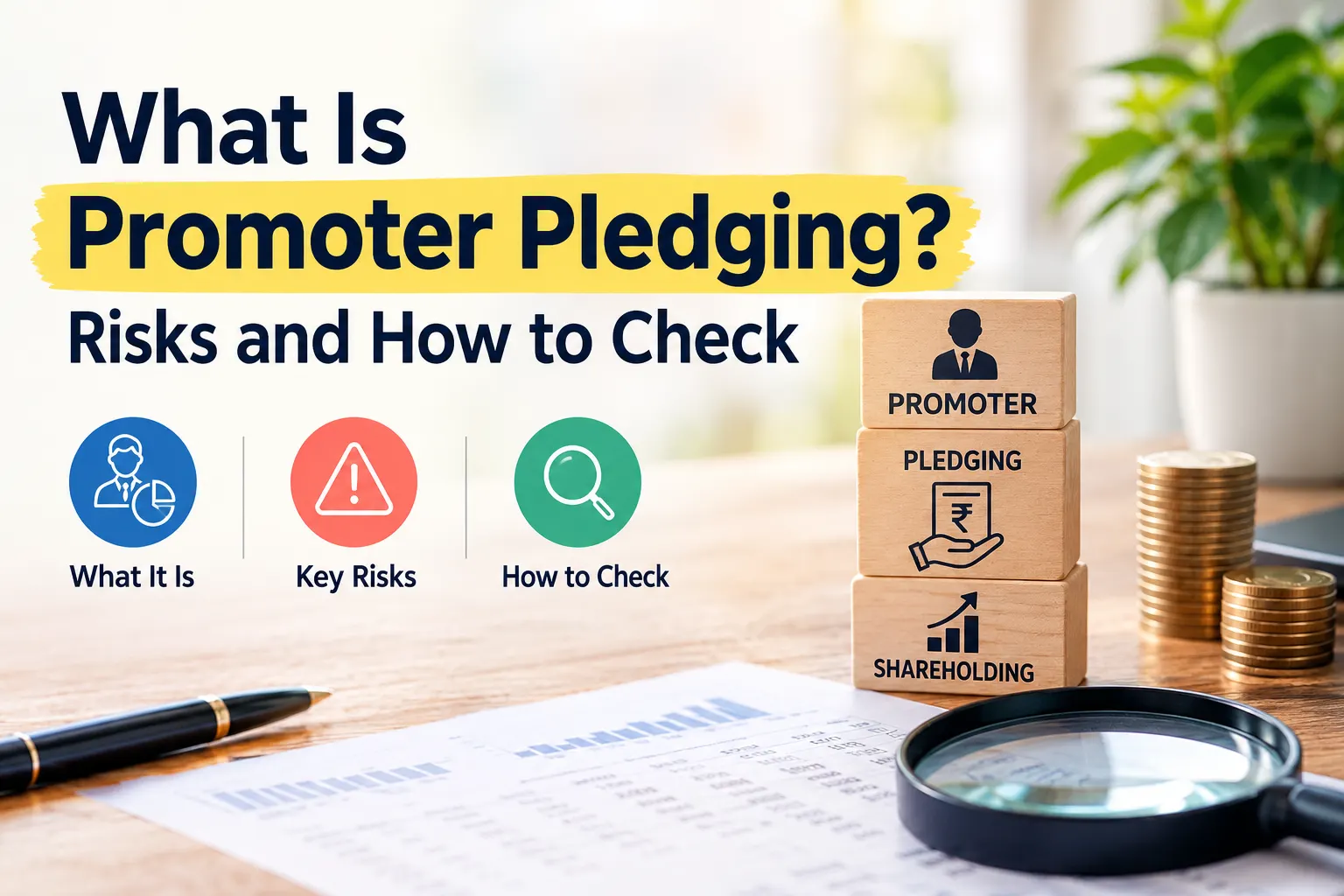
What Is Promoter Pledging in Simple Terms?
Promoters are the founders or the family that controls a listed company. Many of them hold most of their wealth in the company’s own shares. When they need money, selling is awkward: it reduces their control and sends a signal to the market. So they take a loan and hand over some of their shares to the lender as security. That arrangement is promoter pledging.
The shares stay in the promoter’s name, and the promoter usually keeps the voting rights. But the lender now has a claim on them. If the loan is not serviced, or the value of the shares falls below the cushion the lender demands, the lender can invoke the pledge and sell the shares in the market. When the loan is repaid and the lender lets go of the shares, the pledge is released.
Two numbers describe how big a pledge is, and you should always look at both:
- Pledge as a percentage of promoter holding: shares pledged divided by everything the promoter group owns.
- Pledge as a percentage of total share capital: shares pledged divided by all the shares the company has issued.
If a promoter group owns 50% of a company and has pledged shares equal to 10% of the company, then 20% of its holding is pledged, but only 10% of the total capital.
SEBI’s term for all this is encumbrance. Under the takeover regulations it covers pledge, lien, negative lien, non-disposal undertaking (NDU) and any similar arrangement, whether made directly or indirectly. An NDU stops the promoter from selling but does not by itself give the lender a right to sell, so it carries a different kind of risk from a pledge.
Why Do Promoters Pledge Their Shares?
Not every reason is a warning sign. The common ones are:
- Business funding without dilution: raising money for expansion without issuing new shares or selling part of their stake.
- Cheaper borrowing: a loan secured against listed shares usually costs less than an unsecured one.
- Funding other group ventures: the shares of one listed company are often used to raise money for a different business.
- Short-term liquidity: bridging a cash gap instead of selling shares at a poor price.
The third reason deserves attention. When borrowed money goes into a business unrelated to the listed company, minority shareholders carry the risk of the pledge without any claim on what the money builds.
How Does Promoter Pledging Hurt Minority Shareholders When Prices Fall?
The danger is not the loan itself. It is the way the collateral behaves. Lenders do not lend the full value of pledged shares; they keep a cushion. When the price falls and the cushion thins, the lender asks for a top-up, known as a margin call. The promoter can add more shares, add cash or repay part of the loan. A promoter who can do none of these watches the lender invoke the pledge and sell.
Here is how that plays out with assumed numbers. This is an illustration, not any real company.
Setup: A company has 20 crore shares. The promoter group owns 10 crore (50%) and pledges 4 crore of them to raise a loan of ₹400 crore. At ₹200 a share, the pledged shares are worth ₹800 crore, which is 2x cover.
Pledge ratio today: 4 crore shares is 40% of the promoter holding and 20% of total share capital.
The trigger: Assume the lender wants at least 1.5x cover, or ₹600 crore. A margin call arrives when the price drops to ₹150, a fall of 25%.
The top-up: To bring cover back to 2x at ₹150, the pledged block must be worth ₹800 crore, which takes about 5.33 crore shares. The promoter has to pledge roughly 1.33 crore more. The pledge ratio jumps to about 53% of promoter holding and 27% of total capital.
If the promoter cannot pay: The lender sells shares to recover ₹400 crore. At ₹150 that is about 2.67 crore shares. If the stock trades around 20 lakh shares a day, that is more than two weeks of normal volume, and every sale pushes the price lower.
Notice what happens next. The lower price thins the cushion on the remaining pledged shares, which can trigger the next margin call, which leads to more selling. The loop runs on collateral values, not on the company’s earnings.
Indian markets have seen this more than once. In 2009, after Akruti City was pulled out of the F&O segment, its stock fell more than 45% in a day and its promoters had to pledge another 7% of the company’s equity, taking the total pledge to 36%. In January 2019, Zee’s share price dropped about 27%, and its management confirmed that part of the fall came from lenders invoking pledges on promoter-owned shares.
Is Every Promoter Pledge a Red Flag, or Can It Be Harmless?
No. Many sound companies have promoters who pledge a small slice of their holding for genuine funding and release it within a few quarters. What matters is the size, the purpose and the trend.
Lower-concern pattern: A small pledge as a share of promoter holding, raised for the listed company’s own business, with wide cover, a stable or falling trend and plenty of unpledged promoter shares in reserve.
Higher-concern pattern: A large and rising pledge, funds used for unrelated group ventures or to repay older debt, thin cover, repeated top-ups after every price fall and few unpledged shares left to add.
What pledging can do for shareholders:
- The promoter keeps control and skin in the game without diluting anyone.
- Cheaper funding can support growth that benefits all shareholders.
What it can do against them:
- Forced selling can hit the price regardless of business performance.
- A lender can end up owning the shares, and with them a say in control.
- Group-level debt can sit hidden behind a healthy-looking listed company.
One more point that trips up many readers. A falling pledge percentage is not always good news. When the share price rises, the same loan needs fewer shares as collateral, so the ratio can drop without the promoter paying anything back.
How High Can a Promoter Pledge Go Before It Becomes Too High?
There is no official safe limit. SEBI’s own markers are about disclosure: when the combined encumbrance of promoters and the people acting with them reaches 50% of their holding, or 20% of the company’s total share capital, detailed reasons must be filed. Those are not safety lines, but they show where the regulator starts paying attention.
Our working guide at Techolic, to be treated as a rule of thumb and not a regulation:
- Below 10% of promoter holding: usually low concern. Confirm it is not climbing.
- 10% to 30%: watch the trend and the end use of the borrowed money.
- 30% to 50%: elevated. Look closely at cover, the lender and the promoter’s other debts.
- Above 50%: serious. It needs a strong reason, and any position should be sized accordingly.
- Above 75%, and especially above 90%: extreme. Even a modest price fall can set off forced selling.
The extreme end is not empty. A recent analysis of over 4,000 BSE-listed companies found a few dozen where more than 90% of promoter holding was pledged at the end of the June 2026 quarter.
Percentages alone can also mislead. A 40% pledge in a heavily traded large-cap can be absorbed by the market. A 25% pledge in a thinly traded small-cap can wreck the price, because there are simply not enough buyers when the lender starts selling. Always compare the quantity pledged with the stock’s daily traded volume and with the size of the loan against the company’s market value.
Where Can You Check Promoter Pledging for Any Listed Company?
You do not need a paid tool. Everything starts with the exchanges:
- Shareholding pattern. On the NSE or BSE company page, open the latest quarterly shareholding pattern. The promoter and promoter group table shows the number and percentage of shares pledged or otherwise encumbered, and the filing states whether any promoter shares are held under pledge, an NDU or another arrangement. Companies file it within 21 days of each quarter-end.
- Corporate announcements. Search for disclosures under Regulation 31 of the SEBI takeover regulations. These report the creation, invocation or release of an encumbrance, generally within seven working days of the event.
- Annual declaration. Promoters also confirm every year, within seven working days of the financial year-end, that they have made no encumbrance other than those already disclosed.
- Trend. Line up the last six to eight quarters. A single snapshot says little. The direction says a great deal.
Two limits are worth knowing. The shareholding pattern is a quarterly picture and can be weeks old by the time you read it. And the Regulation 31 event disclosures do not apply where the encumbrance is created within the depository system, so you should not expect every pledge to show up as its own announcement. We treat the quarterly pattern as the base and the announcements as a bonus.
What Does the “Reasons for Encumbrance” Disclosure Tell You?
Since October 2019, once the combined encumbrance reaches 50% of the promoter group’s holding or 20% of total share capital, the promoters must file detailed reasons in a prescribed format. It covers the purpose of the borrowing, the security cover provided, whether the loan relates to a debt instrument and its credit rating, and details of the lender.
Here is how to read it:
- End use: Money going into the listed company’s own business is easier to accept than money moved to unrelated group ventures or used to repay older loans.
- Security cover: Higher cover means a bigger cushion before a margin call. Thin cover means a small fall can trigger one.
- Rating and instrument: A rated instrument tells you how outside parties view the borrower’s credit. Unrated or complicated structures deserve more questions.
- Number of encumbrances: Several separate pledges in a short period point to repeated fundraising against the same stock.
What Should You Check in Five Minutes Before Buying a Stock?
When we screen stocks for clients at Techolic, this is the short list we run before anything else:
- Pledge as a percentage of promoter holding and of total share capital, for the latest quarter.
- The direction over the last six to eight quarters.
- How many promoter shares are still unpledged, since that is the cushion for future top-ups.
- The end use, cover and lender details wherever the reasons disclosure is available.
- The pledged quantity compared with the stock’s average daily volume.
- The company’s own debt, interest cover and cash flow, because stress often sits at both levels together.
- The recent price trend. A stock down 30% to 40% from its high while the pledge keeps rising is a classic pressure setup.
A stock with an unexplained high pledge has to clear a much higher bar on every other measure before we take it further.
What Mistakes Do Investors Make With Pledged Shares?
- Treating every pledge as proof of wrongdoing. Size, purpose and trend matter more than the mere presence of a pledge.
- Checking only the latest quarter. A pledge that has doubled in three quarters is a very different story from one that has been flat for years.
- Reading a falling ratio as debt repayment. As explained above, a rising share price can shrink the ratio by itself.
- Ignoring promoter group entities and indirect pledges. The definition of encumbrance covers both direct and indirect arrangements, so look at the whole promoter group.
- Calling a crashed stock “cheap” without checking the pledge. If lenders are still sitting on a large pledged block, the selling may not be over.
- Confusing an NDU with a pledge. They are disclosed together but carry different risks.
- Overlooking liquidity. The same pledge hurts far more in a stock that few people trade.
What Can You Do If You Already Own a Stock With a High Pledge?
This is general information, not a recommendation for any specific stock. A few sensible steps:
- Note the date of the next quarterly filing and compare the pledge with the previous one.
- Size the holding so that a sharp fall does not derail your financial plan.
- Avoid averaging down mechanically while margin calls may be driving the decline.
- Look for real improvement: the promoter releasing pledges, selling non-core assets or cutting group debt.
- Review the position if the pledge keeps rising while the price keeps falling.
If you would like a second pair of eyes on a specific holding, the team at Techolic can walk you through the filings and what they mean for your portfolio.
Frequently Asked Questions – FAQs
What is promoter pledging in simple words?
It is when a company’s promoters borrow money by handing some of their shares to a lender as security. The shares remain theirs unless the loan goes unpaid or the cover falls short, in which case the lender can sell them.
Is a promoter pledge always bad for a stock?
No. A small, well-explained pledge on a stable trend is common and often harmless. The risk grows when the pledge is large, rising, thinly covered or tied to unrelated group borrowings.
How is the pledge ratio calculated?
Divide the number of pledged promoter shares by the total shares held by the promoter group, then multiply by 100. Also compare the pledged shares with the company’s total share capital, because both views matter.
Do promoters have to disclose when a lender sells their pledged shares?
Yes. The promoter must report the invocation of an encumbrance to the stock exchanges and the company, generally within seven working days, under Regulation 31 of the SEBI takeover regulations.
How is a promoter’s pledge different from pledging my own shares with my broker for margin?
When you pledge your own holdings with a broker, you offer them as security for trading margin and they stay in your demat account. A promoter’s pledge is a loan raised by the controlling shareholders, and if it goes wrong the forced selling can pull down the price for every shareholder.
What level of pledge should worry me?
There is no official line. SEBI asks for detailed reasons once the pledge reaches 50% of promoter holding or 20% of total capital. We turn cautious above roughly 30% of promoter holding and treat anything above 50% as serious.
Can a stock with high promoter pledging still be a good investment?
It can be, if the business is strong, cash flows are healthy and the promoter is steadily releasing the pledge. But the downside risk is real, which is why many investors simply avoid heavily pledged names or keep the position small.