If you have a corporate job, chances are HR handed you a health card on day one and told you that you’re “covered.” For most salaried professionals in India, this is where the thinking about health insurance stops. The company has it sorted, so why think about it further?
That assumption is exactly what creates financial trouble at the worst possible time — usually during a medical emergency, when the last thing anyone wants to be doing is reading the fine print of a group health insurance policy for the first time.
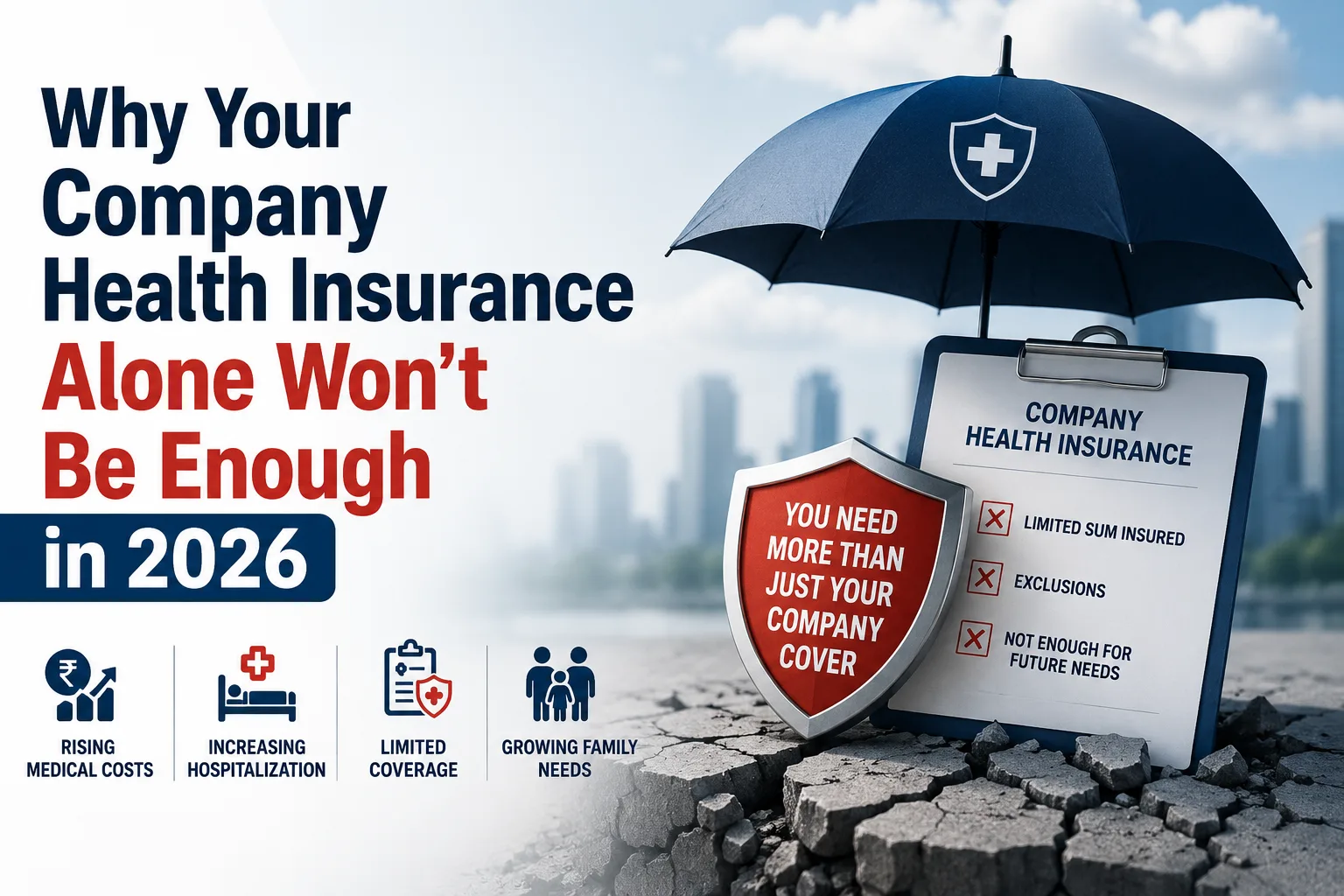
In 2026, this gap between what employees assume their company health insurance policy covers and what it actually covers has only gotten wider. Medical costs are rising faster than most corporate sum insured limits, employment patterns have changed, and a major tax reform has quietly made individual health insurance more affordable than it has ever been — while group policies remain exactly as expensive as before. This article breaks down why relying solely on your employer’s health cover is a risk most people don’t realise they’re taking, and what a more complete approach to health insurance actually looks like.
What Company Health Insurance Actually Covers
A company health insurance policy, more accurately called group health insurance or group medi claim, is a single policy purchased by your employer that covers all eligible employees — and in many cases, their immediate family — under one master agreement.
It typically includes in-patient hospitalisation for surgeries and medical admissions lasting 24 hours or more, pre-hospitalisation expenses for a defined period before admission, post-hospitalisation expenses for a period after discharge, and day-care procedures that don’t require an overnight stay. Many policies today also include maternity benefits and, following recent regulatory changes, coverage for mental health treatment.
On paper, this looks comprehensive. The problem isn’t what’s listed in the policy brochure — it’s the limits, conditions, and gaps that only become visible when you actually need to use it.
How Much Does Your Company Health Insurance Policy Actually Cover?
This is the question almost nobody asks until they’re filling out a claim form. Most corporate group health policies in India provide a sum insured between ₹2 lakh and ₹10 lakh per employee, with many smaller and mid-sized companies sticking to the ₹3–5 lakh range to manage costs.
That number might have felt adequate a decade ago. It doesn’t anymore. A single planned surgery in a good private hospital in a metro city can easily cross ₹4–6 lakh. A serious illness involving an ICU stay, multiple specialists, and an extended recovery period can exhaust a ₹5 lakh sum insured within days. Once your family floater limit under the company plan is used up, you’re paying out of pocket for the rest — at a time when you’re least prepared to absorb a financial shock.
The Five Real Limitations of Relying Only on Company Health Insurance
1. Your Coverage Disappears the Day You Leave Your Job
This is the single biggest risk with company health insurance, and it’s the one most employees genuinely don’t think about until it’s too late. Group health insurance is tied to active employment. The moment you resign, get laid off, or move to a new company, your existing cover ends — often immediately, sometimes with no notice period at all.
Consider a fairly common scenario: an employee resigns from their job in March, planning to take a short break before joining a new company in May. Their company health insurance lapses the day they leave. If a parent needs hospitalisation in April — during that gap — there is no cover in place. This is precisely how families end up paying five or six-figure hospital bills entirely out of pocket, despite having had “insurance” just weeks earlier.
The same risk applies during layoffs, career breaks, sabbaticals, and the transition period of switching jobs. Your health doesn’t pause during that gap. Your insurance does.
2. The Sum Insured Is Rarely Designed Around Your Actual Needs
Group health insurance is purchased by your employer based on a company-wide budget, not your personal medical history, family size, or city of residence. A ₹5 lakh sum insured might be reasonable for a 25-year-old single employee in a smaller city. It is grossly inadequate for a 40-year-old employee in Chandigarh or any tier-1 city, supporting a spouse, two children, and ageing parents.
Healthcare costs in India have been rising at a pace that significantly outstrips general inflation, with industry estimates placing medical inflation in the range of 14% annually in recent years. A sum insured that felt adequate three years ago has effectively shrunk in real terms today, even though the number printed on your health card hasn’t changed.
3. Parents Are Often Excluded or Inadequately Covered
Most standard corporate health insurance policies cover the employee, spouse, and dependent children. Parents — who statistically need hospitalisation far more often and face significantly higher treatment costs due to age-related conditions — are frequently excluded entirely, or included only as an optional add-on with a separate, often modest, sub-limit.
This creates one of the most common and painful financial surprises in Indian households: an employee assumes their “family” health insurance includes their parents, only to discover during an actual hospitalisation that it doesn’t, or that the parent-specific sub-limit is a fraction of the overall family cover.
4. No Underwriting Means No Personal Ownership of the Policy
Group health insurance policies are issued without individual medical underwriting — every employee is enrolled regardless of pre-existing conditions, which is genuinely useful while you’re employed there. But this also means the policy isn’t yours. You don’t choose the insurer, the network hospitals, the room rent limits, or the specific inclusions and exclusions. Your employer renews or changes the policy each year based on their commercial relationship with the insurer, and you have no say in any of it.
If your employer switches insurers, downgrades the sum insured to cut costs, or removes a benefit you were relying on, you find out only when you read the renewed policy document — if you read it at all.
5. Group Health Insurance Has Become Comparatively More Expensive for Employers — and That Pressure Eventually Reaches Employees
A significant shift took place in India’s health insurance landscape from September 2025, when individual health insurance premiums were exempted from GST entirely, dropping the effective tax on individual policies from 18% to zero. Group health insurance, however, was specifically excluded from this exemption and continues to attract 18% GST.
This means individual health insurance has genuinely become more affordable in the last year, while group policies have stayed exactly as expensive for employers as before. As corporate health insurance costs continue rising due to medical inflation and the unchanged 18% tax burden, companies will increasingly look to control costs — frequently by trimming sum insured limits, narrowing networks, or reducing optional covers like parental inclusion. Employees rarely have visibility into these annual changes until they’re affected by one.
Company Health Insurance vs Individual Health Insurance — A Practical Comparison
Understanding where each type of cover genuinely helps — and where it falls short — makes the gap easier to see.
Ownership and continuity Company health insurance ends with your employment. An individual or family floater health insurance policy belongs to you, renews every year regardless of where you work, and stays in force as long as you continue paying the premium.
Sum insured adequacy Company cover is typically ₹2–10 lakh, decided by your employer’s budget. An individual policy can be sized specifically around your city, family composition, and medical history — commonly ₹10–25 lakh for a family in a metro or tier-1 city today.
Parental coverage Often excluded or capped under company plans. A dedicated individual policy for parents, or a senior citizen health plan, can be structured around their actual medical needs.
Cost after the 2025 GST exemption Individual health insurance premiums are now GST-free, making them cheaper to buy than before. Group health insurance premiums remain taxed at 18%, with that cost ultimately influencing how generous employer-funded coverage can afford to be.
Customisation Company policies offer no flexibility — every employee gets the same structure. Individual policies let you choose the sum insured, room rent category, riders like critical illness or maternity cover, and the insurer’s hospital network that fits where you actually live and seek treatment.
Continuity of no-claim benefits A no-claim bonus or cumulative bonus on an individual policy builds up year after year and stays with you. Any such benefit under a group policy resets or disappears the moment you change employers.
Common Mistakes Indian Employees Make With Health Insurance
Assuming “covered” means “adequately covered.” Having a health card from your employer and having sufficient coverage for your family’s actual needs are two very different things. Always check the sum insured, not just the existence of a policy.
Not checking if parents are included. Many employees only discover their parents were never covered, or were covered for a token amount, during an actual hospitalisation — the worst possible time to find out.
Delaying an individual policy because “the company already covers me.” Health insurance premiums increase with age, and any pre-existing condition that develops while you’re relying solely on company cover can make individual insurance harder or costlier to obtain later. Buying early, while healthy, locks in better terms.
Not accounting for the job-change gap. Between resigning from one company and the new employer’s policy becoming active, there is frequently a coverage gap of several weeks. An individual policy ensures this gap is never a real risk.
Ignoring sub-limits and room rent caps. Many group policies cap room rent at a specific daily amount. Choosing a higher category room than the policy allows often triggers a proportionate deduction across the entire claim — not just the room charges — significantly reducing the payout.
Treating health insurance as a one-time decision. A policy that was sufficient five years ago, before marriage or children, is rarely sufficient today. Coverage needs to be reviewed periodically, not set once and forgotten.
What a Genuinely Adequate Health Insurance Strategy Looks Like in 2026
The most financially sound approach isn’t choosing between company health insurance and an individual policy — it’s using both, with each serving a different purpose.
Treat your employer’s group health insurance as a useful, no-cost supplementary benefit while you’re employed there. Treat an individual or family floater health insurance policy, sized appropriately for your city and family, as your permanent foundation — the one that doesn’t disappear when you switch jobs, take a career break, or retire.
For most salaried families in a tier-1 city like Chandigarh, this means an individual family floater policy with a sum insured in the ₹10–20 lakh range, separate and adequate coverage for parents given their higher likelihood of hospitalisation, and a clear understanding of sub-limits, room rent caps, and waiting periods before a policy is purchased rather than after a claim is filed.
This is exactly where the right guidance matters more than the lowest premium. At Techolic, we help clients in Chandigarh evaluate their existing company health insurance honestly — what it covers, where the real gaps are, and how much additional individual cover actually makes sense for their specific family situation. Health insurance is not a product you should be buying off a comparison website without understanding the fine print; it’s a decision worth a proper conversation with someone who can walk through the policy document with you and explain what each clause means in practice.
Frequently Asked Questions
Is company health insurance enough, or do I need a separate personal policy?
For most employees, company health insurance alone is not enough. It typically offers a limited sum insured, ends with your employment, and may not adequately cover your parents. A separate individual health insurance policy provides continuous, ownership-based coverage that doesn’t depend on your job status.
What happens to my company health insurance if I resign or lose my job?
Your group health insurance coverage typically ends on your last working day, or shortly after. There is no continuation period in most cases. Any health insurance need arising after that date — until your new employer’s policy activates or you secure individual cover — would need to be paid out of pocket.
Has the GST exemption made individual health insurance cheaper than before?
Yes. From 22nd September 2025, GST on individual health insurance premiums, including family floater and senior citizen plans, was reduced from 18% to zero. This makes individual policies meaningfully more affordable than they were previously. Group health insurance was not included in this exemption and continues to attract 18% GST.
Why doesn’t my company health insurance cover my parents?
Most employers structure group health insurance to cover the employee, spouse, and dependent children to manage overall premium costs, since older dependants statistically claim more frequently and at higher amounts. Parental coverage, where offered, is often a separate, limited add-on rather than part of the core family cover.
How much individual health insurance cover do I need on top of my company policy?
This depends on your city, family size, and existing company cover, but a commonly recommended range for a family in a metro or tier-1 city today is ₹10–20 lakh, given current hospitalisation costs and medical inflation. A personalised assessment based on your specific situation is more reliable than a generic figure.
Should I buy individual health insurance even if I’m young and healthy?
Yes. Premiums are lowest when you’re young, and buying early — before any health condition develops — ensures you aren’t denied coverage or charged a loading later for a condition that didn’t exist when you first applied.