
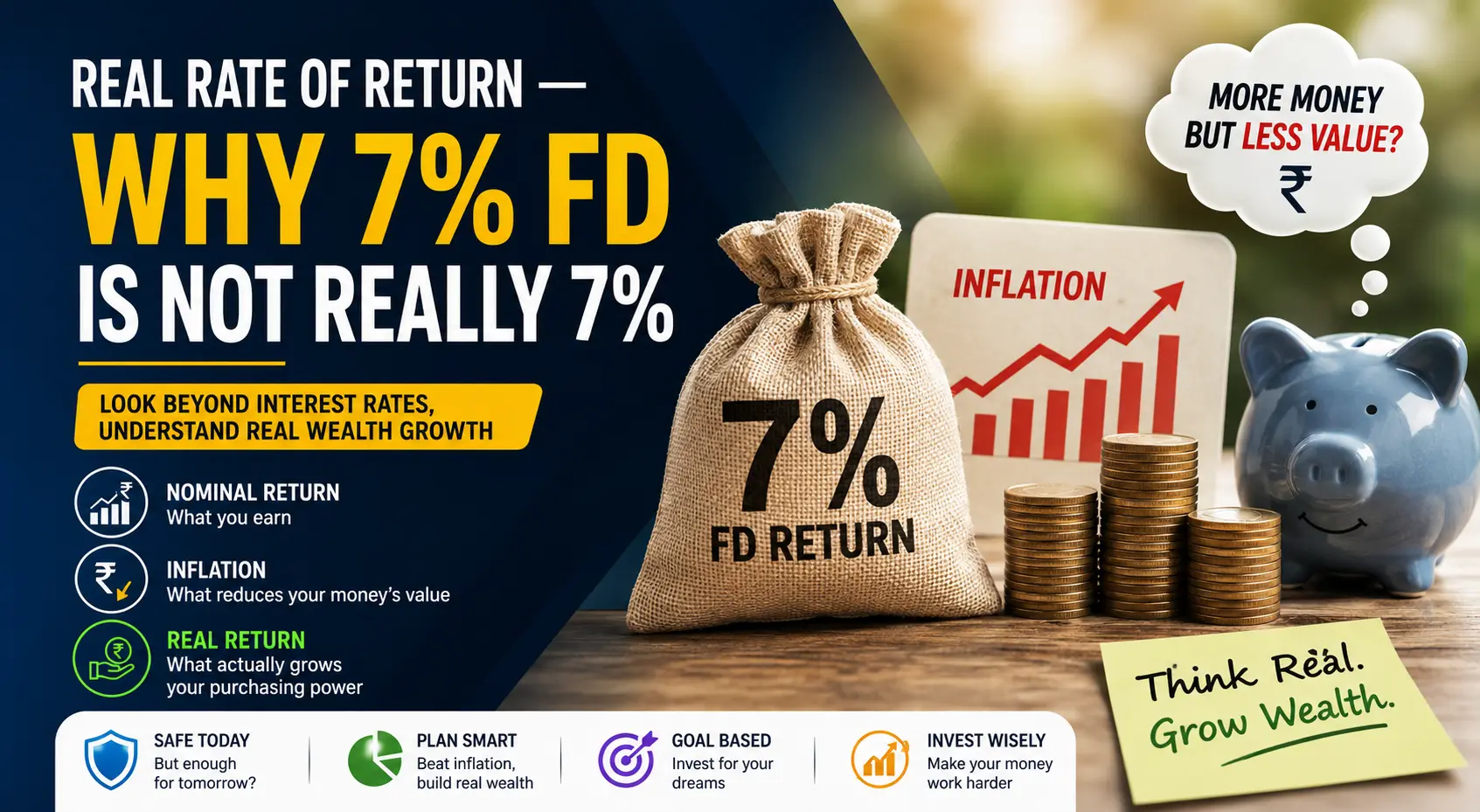
Introduction: The Hidden Cost of Playing It Safe
Ask any Indian investor where they would keep their hard-earned savings, and Fixed Deposits (FDs) will almost always feature near the top of the list. For decades, FDs have been viewed as one of the safest investment options available. They offer predictable returns, minimal risk, and the comfort of knowing exactly how much money you will receive at maturity.
Imagine a bank offering a 7% FD return. At first glance, it seems like a good deal. If you invest ₹10 lakh, you expect to earn ₹70,000 annually before taxes. Many investors stop their analysis there and conclude that their wealth is growing at 7% every year.
However, there is a major factor that often gets ignored: inflation.
The cost of groceries, healthcare, fuel, education, housing, and everyday essentials continues to rise year after year. As prices increase, the purchasing power of your money decreases. This means that while your bank balance may be growing, the actual value of your money may not be increasing as much as you think.
This is where the concept of the Rate of Return becomes far more important than simply looking at interest rates. Successful investors understand that wealth creation is not about how much money you earn on paper. It is about how much your purchasing power grows after accounting for inflation and taxes.
In this article, we will explore the concept of the real rate of return, understand why a 7% FD return is often much lower than it appears, compare FDs with the Stock Market, and learn how Indian investors can make smarter investment decisions that genuinely build wealth over time.
What Is the Real Rate of Return?
The Real Rate of Return measures the actual growth of your money after adjusting for inflation. It provides a more accurate picture of whether your investment is helping you become wealthier in real terms.
Most investment products advertise what is known as a nominal return. This is simply the return earned before considering inflation. For example, if your Fixed Deposit offers 7% annual interest, then 7% is your nominal return.
However, if inflation during the same period is 6%, your purchasing power has increased by only about 1%.
In simple terms:
Real Return = Nominal Return – Inflation Rate
The real rate of return tells you how much more goods and services you can buy in the future compared to today.
This distinction is extremely important because financial goals such as retirement, children’s education, buying a house, and wealth creation are all affected by inflation. Ignoring inflation can lead to an overestimation of how much your investments are actually helping you progress financially.
Why Should Investors Focus on Real Returns Instead of Advertised Returns?
Many investors feel happy when they see their investments growing year after year. However, a growing account balance does not necessarily mean growing wealth.
The true purpose of investing is not simply to increase the number of rupees in your account. The goal is to increase your purchasing power.
Consider this simple example:
Suppose you invested ₹1 lakh in an FD that generated a 7% return. After one year, your investment grows to ₹1.07 lakh.
At first glance, you have earned ₹7,000.
But what if inflation during the same period was 6%?
The products and services that cost ₹1 lakh last year now cost approximately ₹1.06 lakh.
In reality, your purchasing power increased by only about ₹1,000.
This is why professional investors, financial planners, and wealth managers pay close attention to real returns rather than simply focusing on headline returns.
Understanding Nominal Return vs Real Return
What Is a Nominal Return?
A nominal return is the return displayed by an investment product before adjusting for inflation.
Examples include:
- 7% FD return
- 8% government bond yield
- 10% debt fund return
- 12% mutual fund return
These numbers show how much your investment grows in rupee terms but do not reveal whether your purchasing power has actually increased.
For this reason, nominal returns can sometimes create a false sense of financial progress.
What Is a Real Return?
A real return takes inflation into account and measures how much wealth has actually been created.
For example:
- Investment Return: 7%
- Inflation: 6%
Real Return ≈ 1%
This means that while your money grew by 7%, your ability to buy goods and services improved by only 1%.
When planning for long-term financial goals, real returns provide a much more realistic assessment of investment performance.
Why a 7% FD Is Not Really 7%
How Inflation Reduces Your Purchasing Power
Inflation is often called the silent enemy of investors because it gradually reduces the value of money without attracting much attention.
Most people notice inflation when fuel prices increase or when grocery bills become more expensive. However, inflation affects every aspect of life, including healthcare costs, education expenses, rent, transportation, and entertainment.
Suppose a family’s monthly household expenses are ₹50,000 today. If inflation averages 6% annually, those same expenses could exceed ₹89,000 after ten years.
Now imagine an investment that earns only slightly more than inflation. While the account balance increases, the investor may struggle to maintain the same standard of living in the future.
This is exactly why understanding the true Rate of Return is critical. Inflation doesn’t need to eliminate your returns completely to hurt your financial progress. Even small differences can have a major impact over long periods.
Understanding the Difference Between Money Growth and Wealth Growth
Many investors mistakenly assume that a larger bank balance automatically means greater wealth.
In reality, money growth and wealth growth are two different concepts.
Money growth refers to the increase in the number of rupees you own. Wealth growth refers to the increase in what those rupees can actually buy.
Consider an investor who earns a 7% FD return every year while inflation averages 6%.
Technically, their money is growing.
However, the increase in purchasing power is very small.
Now compare this with an investment earning 12% annually while inflation remains at 6%.
In this case, the investor is creating substantially more wealth because the gap between investment returns and inflation is much larger.
This difference becomes even more significant when investments are held for decades.
Why Taxes Make FD Returns Even Lower
Inflation is not the only factor reducing returns. Taxes also play an important role.
Interest earned from Fixed Deposits is fully taxable according to an investor’s income tax slab.
For example, consider an investor in the 30% tax bracket.
If the FD offers a 7% return:
- Gross Return = 7%
- Tax Impact = 30%
- Net Return ≈ 4.9%
Now assume inflation is running at 6%.
The investor’s post-tax return is actually lower than inflation.
In practical terms, this means the investment has failed to increase purchasing power despite generating interest income.
Many investors evaluate only the advertised FD return without calculating the post-tax outcome. This can lead to unrealistic expectations regarding long-term wealth accumulation.
A Real-Life Example: ₹10 Lakh Investment Over 10 Years
Let’s see how inflation impacts actual wealth creation.
Assume:
- Investment Amount = ₹10 lakh
- FD Interest Rate = 7%
- Inflation Rate = 6%
- Investment Period = 10 Years
After ten years, the FD grows to approximately ₹19.67 lakh before taxes.
At first glance, this seems like excellent growth.
However, due to inflation, the purchasing power of that ₹19.67 lakh is much lower than it appears.
Goods and services costing ₹10 lakh today would cost nearly ₹17.9 lakh after ten years with 6% inflation.
In real terms, the investor’s purchasing power has increased only marginally despite nearly doubling the account balance.
This example highlights why investors should always look beyond nominal figures when evaluating investment performance.
How to Calculate the Real Rate of Return
A Simple Method for Everyday Investors
Most investors do not need complex financial calculators.
A basic approximation works well for understanding real returns:
Real Return = Investment Return – Inflation
For example:
- FD Interest = 7%
- Inflation = 6%
Real Return = 1%
This simple calculation can help investors quickly assess whether an investment is genuinely creating wealth.
Why the Calculation Matters
Many financial goals stretch over decades.
Examples include:
- Retirement planning
- Children’s higher education
- Home ownership
- Wealth accumulation
- Financial independence
When planning for these goals, inflation can significantly alter outcomes.
An investment that appears attractive on paper may not generate enough real growth to achieve future objectives.
Therefore, understanding your actual Rate of Return can help you choose investments that better align with your financial goals.
FD vs Stock Market: Which Generates Better Real Wealth?
How Fixed Deposits Generate Returns
Fixed Deposits generate returns through interest payments. Investors know in advance how much they will earn and when they will receive their money.
This predictability is one of the biggest reasons FDs remain popular among Indian investors.
However, the trade-off for safety is often lower growth potential.
While FDs provide stability, they may struggle to outperform inflation significantly over long periods.
How the Stock Market Creates Wealth
The Stock Market works differently.
When investors buy shares of businesses, they participate in the growth of those companies.
As businesses expand revenues, increase profits, and create shareholder value, stock prices often rise over time.
Unlike Fixed Deposits, stock prices fluctuate daily. However, over long periods, quality businesses have historically generated returns that exceed inflation by a meaningful margin.
This inflation-beating potential is one reason why long-term investors often allocate a portion of their portfolios to the Stock Market.
Comparing ₹1 Lakh in FD and Stock Market Over 20 Years
Consider two investors:
Investor A – Fixed Deposit
- Investment: ₹1 lakh
- Return: 7%
- Period: 20 years
Final Value ≈ ₹3.87 lakh
Investor B – Equity Investment
- Investment: ₹1 lakh
- Return: 12%
- Period: 20 years
Final Value ≈ ₹9.65 lakh
Even after adjusting for inflation, the difference remains substantial.
This demonstrates why long-term wealth creation often requires exposure to growth assets in addition to traditional savings instruments.
When an FD Is Better Than the Stock Market
Fixed Deposits may be suitable when:
- Capital preservation is the priority.
- Money is needed within a few years.
- An emergency fund is being maintained.
- The investor cannot tolerate market fluctuations.
In these situations, stability may be more important than maximizing returns.
When the Stock Market May Be More Suitable
The Stock Market may be appropriate when:
- Investment horizons exceed 10 years.
- The goal is long-term wealth creation.
- Inflation protection is important.
- Investors can tolerate short-term volatility.
A disciplined and diversified approach can help investors benefit from the long-term growth potential of equities.
Common Mistakes Investors Make
Focusing Only on Interest Rates
Many investors chase the highest FD rate without considering inflation and taxes. A higher interest rate is beneficial, but it should not be the only factor influencing investment decisions.
Ignoring Inflation Completely
Inflation silently affects every financial goal. Failing to account for inflation can result in serious planning errors.
Assuming Safe Investments Always Create Wealth
Safety protects capital, but it does not necessarily generate meaningful growth in purchasing power.
Not Diversifying Investments
Keeping all savings in one asset class increases risk and may limit wealth creation opportunities.
Confusing Savings With Investing
Saving preserves money. Investing aims to grow money faster than inflation. Understanding this difference is essential for long-term financial success.
How Investors Can Improve Their Real Rate of Return
Diversify Across Multiple Asset Classes
A diversified portfolio can balance safety, liquidity, income, and growth.
Combining Fixed Deposits, mutual funds, equities, and other investments often produces better long-term outcomes than relying on a single asset class.
Focus on Long-Term Investing
Time is one of the most powerful tools available to investors.
Long-term investing allows compounding to work effectively while helping investors overcome short-term market fluctuations.
Evaluate Post-Tax Returns
The return that matters is not the advertised return but the amount you actually keep after taxes.
Always compare investments on an after-tax basis.
Review Investments Regularly
Economic conditions change over time. Inflation, interest rates, and market performance can all affect investment outcomes.
Periodic reviews help ensure your portfolio remains aligned with your goals.
Techolic’s Perspective on Real Returns
At Techolic, we believe investors should look beyond headline numbers and focus on genuine wealth creation. A 7% return may sound attractive, but what matters is how much purchasing power remains after inflation and taxation.
Before selecting any investment, ask yourself:
- Is this investment beating inflation?
- What will the return look like after taxes?
- Does it support my long-term financial goals?
- Am I creating wealth or merely preserving money?
These questions can help investors make smarter, more informed financial decisions.
Conclusion
A 7% Fixed Deposit may not truly deliver a 7% increase in wealth. Once inflation and taxes are taken into account, the actual gain can be significantly lower. This is why understanding the real Rate of Return is essential for anyone serious about building long-term financial security.
Fixed Deposits remain valuable tools for stability, liquidity, and capital preservation. However, investors should recognize their limitations when it comes to inflation-adjusted wealth creation.
By focusing on real returns instead of headline returns, Indian investors can make better decisions, set realistic expectations, and build portfolios that are designed not only to grow money but also to protect purchasing power for years to come.
Frequently Asked Questions (FAQs)
What is the difference between nominal return and real return?
Nominal return is the return shown by an investment before considering inflation. Real return adjusts for inflation and reflects the actual increase in purchasing power.
Why is inflation important when evaluating investments?
Inflation determines how much goods and services will cost in the future. If investment returns do not significantly exceed inflation, real wealth creation becomes difficult.
Can a 7% FD generate negative real returns?
Yes. If inflation is close to or higher than the post-tax return from the FD, the investor may experience negative real returns despite earning interest.
Is FD safer than the Stock Market?
Yes, Fixed Deposits generally offer greater capital protection. However, the Stock Market has historically provided higher long-term growth potential and better inflation-beating returns.
What is considered a good real rate of return?
A positive real return that consistently exceeds inflation is generally desirable. The higher the gap between investment returns and inflation, the greater the wealth creation potential.
Should investors avoid FDs completely?
No. FDs serve an important purpose for emergency funds, short-term goals, and conservative investors. They should be viewed as part of a diversified financial strategy rather than the sole investment vehicle.