
Nearly nine in ten individual traders in India’s equity derivatives segment ended FY26 with a net loss, according to SEBI’s latest study of trading behaviour, published in August 2026. The year before, the figure was around 91%. Almost all of these traders dealt in options, and the losses tended to repeat: among traders who had lost money in each of the previous two years and kept trading, roughly 90–92% lost again the next year.
Those numbers are about F&O. But there is a quieter problem sitting underneath them, and it starts with how people set up their accounts. Many Indian investors run SIPs, hold shares for years and trade weekly options through the same app, the same ledger and the same stock broker. The account was opened for one job and is now being asked to do a very different one.
This guide explains why investing and F&O pull a broker in opposite directions, what each activity actually costs after the 2026 changes in STT and F&O rules, how the tax treatment differs, and how to arrange your accounts so that long-term money and trading money never end up in the same pool by accident. We have written it the way we would explain it to a client sitting across from us at Techolic.
Why do investors and F&O traders need different things from a stock broker?
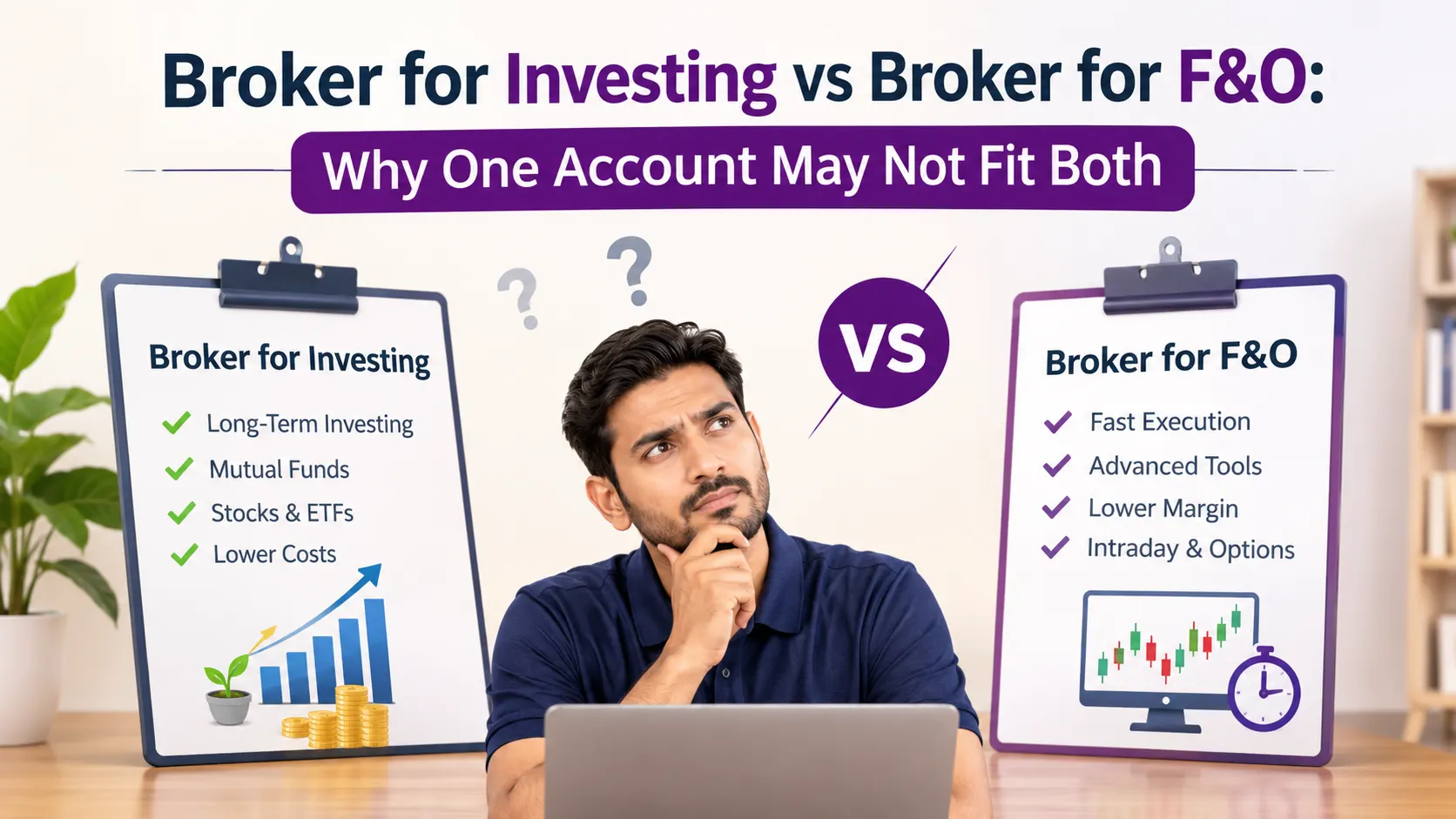
Investing and F&O look alike on the screen because both begin with a buy button. Underneath, they are different activities.
Investing in shares is ownership. You buy a part of a business, hold it for years, and your result depends on how that business grows. You place a handful of orders in a year. What you need from your broker is dependable custody, clean reporting, easy access to mutual funds and IPOs, and low costs for simply holding.
F&O trading is a contract on price movement over days or hours. Leverage is built into the product, contracts expire, and decisions repeat dozens of times a month. What you need is fast execution, accurate margin information, tools to manage risk, and a platform that does not freeze when everyone trades at once.
What an investor feels most: annual and holding charges, quality of holdings and capital gains reports, access to mutual funds, IPOs and bonds.
What an F&O trader feels most: per-order costs, execution quality, margin and position-sizing tools, platform stability on expiry day.
There is also a difference in incentives that rarely gets discussed. A broker earns very little from a customer who buys a share once and holds it for ten years. It earns far more from a customer who trades options every week. Apps are designed accordingly: the option chain is one tap away, while the capital gains report is buried in a menu. Knowing this does not make a broker bad, but it explains why an app that feels great for trading can feel noisy for investing.
How does the cost structure differ between delivery investing and F&O?
Both activities carry the same family of charges, but the weight of each charge is very different. For a long-term investor, the costs that matter are the ones that repeat every year. For an F&O trader, the costs that matter are the ones attached to every single order.
One thing is now common to all brokers. Since 1 October 2024, SEBI’s “true to label” rule requires exchanges to charge every broker the same rate, so the exchange transaction charge on your contract note is what the exchange actually receives. This means exchange charges are no longer a point of comparison between brokers. What still differs is brokerage, DP charges, account maintenance charges and other items in the tariff sheet.
What does a delivery investor actually pay?
- Brokerage: often nil on delivery trades at discount brokers, a percentage of trade value at traditional full-service brokers.
- STT: 0.1% on both the buy and sell value of delivery trades. Budget 2026 did not change this.
- DP charge: a flat fee each time you sell shares, usually in the range of ₹13–25 plus GST per stock per day. It does not grow with trade size, and it applies even at a “zero brokerage” broker.
- Annual maintenance charge (AMC): anywhere from nil to a few hundred rupees a year plus GST, charged whether or not you trade.
- Other statutory charges: exchange transaction charges, SEBI turnover fee (₹10 per crore), stamp duty and 18% GST on applicable charges.
What does an F&O trader actually pay?
- Brokerage: usually a flat amount per executed order, so it multiplies with every trade.
- STT, as revised from 1 April 2026: 0.05% on the sell side of futures (earlier 0.02%), 0.15% on the premium when options are sold (earlier 0.10%), and 0.15% on exercised options (earlier 0.125%).
- Exchange charges, SEBI fee, stamp duty and GST: small per trade, but they add up with frequency.
- Margin-linked charges: pledge and unpledge fees, interest or penalties on cash shortfall, and in some cases higher brokerage when margin norms are not met.
Illustrative example: a delivery investor (assumptions, not a forecast). Suppose you buy shares worth ₹1,00,000, hold them for 13 months and sell at ₹1,20,000. STT is ₹100 on the buy and ₹120 on the sell. Assume a DP charge of ₹20 plus GST (₹23.60) and an AMC of ₹300 plus GST (₹354) for the year. The visible cost comes to roughly ₹600, which is about 0.6% of the money invested and about 3% of the ₹20,000 gain. Because the gain is within the ₹1.25 lakh annual exemption on long-term equity gains, there would be no capital gains tax, assuming no other long-term gains that year.
Illustrative example: an F&O trader (assumptions, not a forecast). Take one Nifty options lot of 65 units. You buy at a premium of ₹150 (₹9,750) and sell at ₹165 (₹10,725), a gross gain of ₹975. Assume flat brokerage of ₹20 per order, so ₹40 plus ₹7.20 GST. STT at 0.15% on the sell premium is about ₹16. The visible cost is around ₹63, which already takes about 6.5% of the gross gain, before exchange charges and stamp duty. Now repeat this 50 times in a month. Even if every trade merely broke even before costs, you would pay about ₹3,150 in a month, which is over 6% of a ₹50,000 trading account.
The same arithmetic applies to futures. A Nifty futures lot at an index level of 25,000 has a contract value of about ₹16.25 lakh. At the new STT rate of 0.05%, selling that lot attracts about ₹812 in STT, compared with about ₹325 at the old 0.02% rate.
The point of these examples is not that F&O is expensive and investing is cheap. It is that the two activities are sensitive to different costs. A broker that is cheap for one can quietly be costly for the other.
What should an investor look for in a stock broker?
If your money is meant to stay invested for years, judge a broker on how well it looks after the long game. At Techolic, these are the points we ask investors to check before anything else.
- Low or no AMC and a fair DP charge. These are the costs that repeat every year, regardless of your returns.
- Easy access to direct mutual funds, SIPs and SWPs inside the same platform, so you are not forced to use multiple apps.
- IPO and bond access with a simple UPI-based application process.
- Holdings and capital gains reports that you can download without effort. These save hours at tax time and reduce errors.
- Clear policies on authorisation for selling shares, such as the TPIN or eDIS process, so a sale does not fail at the last moment.
- A calm interface. If the app keeps nudging you towards options, you will end up trading more than you planned.
A common mistake here is choosing a broker on brokerage alone. For a buy-and-hold investor, brokerage on delivery is often nil at most discount brokers, so the real differences lie in AMC, DP charges and the quality of reporting.
What should an F&O trader look for in a broker?
Someone trading derivatives needs a different checklist, and the stakes are higher because leverage magnifies every operational problem.
- Platform stability and execution speed, especially on expiry days and during major news events.
- Accurate, real-time margin information. You should know before placing an order how much margin it needs, and see a clear warning when you are close to a shortfall.
- Position-sizing and risk tools, such as stop-loss orders, basket orders and a reliable option chain.
- Transparent per-order brokerage, with a clear explanation of when extra charges apply.
- A clear policy on margin shortfall and square-off, so you know exactly when and how positions get closed.
- API access and algo-friendliness, if you trade systematically. Remember that SEBI has been tightening the rules around algorithmic trading, so check what your broker supports.
The most common mistake is trading F&O on a platform built for investors. It may not give you fast order modification, clear margin snapshots or reliable alerts, and those gaps show up when volatility is highest.
What has changed in F&O rules, and why does it affect where you trade?
SEBI has tightened the derivatives framework in steps since November 2024, mainly to reduce speculative trading by small accounts. If you last looked at F&O a few years ago, the product you remember has changed.
- Larger contracts. The minimum contract value for index derivatives was raised to ₹15–20 lakh. Lot sizes are revised periodically to keep contracts in this range. Nifty’s lot size is currently 65 units, so check the exchange circular for the latest figure.
- Fewer weekly expiries. Each exchange now offers weekly expiry on only one benchmark index.
- Upfront premium for option buyers. From 1 February 2025, brokers must collect the full option premium upfront from buyers. Intraday credit for buying options is no longer allowed.
- Extra margin on expiry day. Additional margin applies to short option positions on expiry day, and the calendar spread benefit on that day has been removed.
- Intraday monitoring of position limits. Since 1 April 2025, position limits are checked several times during the day instead of only at the close.
- No extra intraday leverage. Under the peak margin framework, brokers cannot offer intraday leverage above the minimum exchange margin, and shortfalls attract penalties.
- Higher STT. As covered above, STT on futures and options rose again from 1 April 2026.
What does this mean for your accounts? Margins are higher, mistakes cost more, and a small experiment with F&O now needs a meaningful amount of capital. Margins for a short Nifty option position have recently been quoted at roughly ₹1.6–2 lakh per lot, though they change with volatility. That makes it even more important not to fund F&O from your long-term investments by default.
Can you use one account for both investing and F&O, and what are the risks?
Technically, yes. Once the F&O segment is activated on your trading account, the same login can hold your long-term shares and your option positions. Plenty of people do this and manage it sensibly. The convenience is real: one KYC, one ledger, one place to move funds.
The risk is not technical. It is that the two pools of money can start to blur, and the mechanism that blurs them is margin pledge.
How does margin pledge connect your investments to your F&O positions?
When you pledge your holdings, the shares stay in your demat account but are marked as collateral. You receive margin against them after a haircut, which is a deduction for market risk. Haircuts typically range from about 5% to 25% depending on the security and market conditions, and they can change. Authorising a pledge requires an OTP or TPIN-based confirmation through the depository.
There is an important limit. Exchanges expect at least half of the margin for F&O positions to be in cash or cash equivalents, and most brokers apply this as a 50:50 rule for overnight positions. Pledged shares can cover only the other half.
Illustrative example (assumptions, not a forecast). You hold ₹5,00,000 of large-cap shares for long-term goals. At a 20% haircut, pledging them gives ₹4,00,000 of collateral margin. Suppose your F&O positions need ₹2,00,000 of margin. You must still keep at least ₹1,00,000 in cash, and the rest can come from collateral. Now the positions lose ₹1,50,000. Your cash of ₹1,00,000 is not enough, so the ledger goes into a ₹50,000 debit. Depending on your broker’s terms, you may receive a margin call, positions may be squared off, or holdings may be sold. Shares meant for retirement are now paying for an options loss.
Pledged shares can also be affected at expiry. In stock F&O contracts, which are settled by physical delivery, shares held as collateral may be considered for delivery obligations if the contract expires in the money.
What are the other risks of mixing both in one account?
- Blurred accounting. Long-term holdings and trading positions sit in the same view, so you lose track of how much you have actually made or lost on each side.
- A cost model that fits only one use. The broker that charges the least for delivery may not be the one with the best tools for F&O, and the reverse is also true.
- The temptation to “use” idle holdings. A portfolio sitting in the demat account starts to look like free margin, which is exactly how long-term money ends up in short-term risk.
What a single account does well: convenience, a single KYC, easy fund movement, and straightforward use of options for occasional hedging.
What a single account does badly: keeping long-term capital separate from trading capital, and matching broker features to two different activities.
How are delivery investing and F&O taxed differently?
The tax treatment is entirely different, and mixing the two without understanding this causes the most confusion at return-filing time.
Delivery-based equity investing (capital gains): gains on listed shares held for 12 months or less are taxed at 20%. Gains on shares held longer are taxed at 12.5% on the amount above ₹1.25 lakh in a financial year, without indexation. Budget 2026 left these rates unchanged for FY 2026-27.
F&O trading (business income): profits and losses from futures and options are treated as non-speculative business income. This means you generally file ITR-3, not a simple return, and your profit is added to your other income and taxed at your slab rate. Trading expenses such as brokerage and STT are generally claimed against this income, so you need the broker’s profit and loss statement and ledger.
Intraday equity trading: profits and losses from buying and selling shares within the same day are treated as speculative business income, a separate category from F&O.
F&O losses: a non-speculative business loss can be set off against income under other heads except salary in the same year. Any balance can be carried forward for up to eight years, but only against future non-speculative business income, and only if you file your return on time.
Tax audit: depending on your turnover and profit, tax audit rules may apply. F&O turnover is computed by a specific method and is not the same as the contract value you traded. A chartered accountant can calculate it from your broker’s reports.
One point is easy to miss. Opening a second account with another broker does not separate your taxes. Everything is linked to your PAN and reported in one return. Separating accounts helps with discipline and record-keeping, but it does not change how the income is taxed.
Is opening a second account the right solution?
There is no SEBI cap on the number of demat or trading accounts you can hold across different brokers, and the usual practice is one trading account per broker for each person. Each demat account may carry its own AMC, so more accounts mean more recurring costs. Within that, you broadly have three ways to set things up.
Option 1: One broker, one account. Best for pure investors and for people who trade very occasionally. It is the simplest and cheapest, but it needs strong personal discipline, especially around pledging.
Option 2: Two brokers, one for investing and one for trading. This keeps long-term holdings completely out of reach of F&O margin. It costs more in AMC and takes more effort, but it solves the pledging problem by design. It also lets you pick a broker for each job.
Option 3: One broker, F&O activated only when needed. Useful for investors who occasionally hedge or who want the option of trading later. Keep the F&O segment switched off until you have a specific reason to use it.
Which setup fits you?
You are a long-term investor who buys shares and mutual funds and never trades derivatives. Use one account with a broker that is strong on reporting, mutual funds and low holding costs. Leave F&O switched off.
You are an investor who occasionally hedges. Keep long-term holdings in one account. Remember that a Nifty contract is worth ₹15–20 lakh, so hedging a small portfolio with index options is rarely precise. Get advice before attempting it.
You trade F&O actively. Open a separate account, ideally with a broker chosen for platform quality, and fund it only with money you can afford to lose. Do not pledge long-term investments for margin.
You do both in substantial size. Keep them in different accounts, preferably with different brokers, and treat trading capital as a separate budget with a fixed limit.
What are the common mistakes?
- Pledging long-term shares as F&O margin without thinking through the shortfall scenario.
- Ignoring DP charges and AMC because brokerage looks like zero.
- Assuming that “zero brokerage” covers every charge. STT, exchange charges, GST and DP charges still apply.
- Choosing a broker for one activity and using it for both.
- Not tracking trading profit and loss separately, which makes ITR-3 filing and loss carry-forward harder.
- Filing F&O results as capital gains. They are business income and belong in a different schedule.
- Skipping the tariff sheet and the most important terms and conditions document before opening an account.
- Treating F&O as a way to recover investing losses, which usually increases position size at the worst moment.
How do we think about this at Techolic?
When a new client meets us at Techolic, the first question we ask is not which broker or which product. It is: what is this money for? Retirement, a child’s education and a house down payment need different treatment from a monthly trading budget. Once that is clear, the account structure often becomes obvious.
For most investors, the answer is a clean long-term investing account and, for those who want to trade, a small and separate trading pool. The investing account stays boring on purpose. We would rather a client build wealth slowly than win a few trades and lose a retirement fund.
If you are unsure where you fall, we would encourage you to write down how much of your net worth is in long-term investments and how much you are willing to risk in F&O. If you cannot answer the second number, that is a signal to slow down.
How do you check a stock broker before opening any account?
Whichever stock broker you pick for either activity, run these checks first.
- Registration: confirm the broker is registered with SEBI through the exchange’s own member directory.
- Tariff sheet: read the full charge list, including DP, AMC, pledge and margin shortfall charges, not just the brokerage headline.
- Most important terms and conditions: the one-page summary that brokers must provide shows the key rules on risk management and square-off.
- Complaint record: brokers publish investor complaint data on their websites. Compare it before you commit.
- Warning signs: SEBI’s 2026 stock broker rules specifically prohibit guaranteed-return schemes, informal pooling of client money and cash dealings. Anyone offering these is outside the rules.
Frequently asked questions
Can I invest and trade F&O from the same demat and trading account?
Yes, once the F&O segment is activated on your account. Many people do. The risk is that long-term holdings can be pledged as margin and used to cover F&O losses, so you need to be disciplined about keeping the two pools apart.
Is it legal to have accounts with two different brokers?
Yes. SEBI does not limit the number of demat or trading accounts you can hold across different brokers, as long as each is linked to your PAN. Each account may carry its own AMC and charges.
Do I need shares in a demat account to trade F&O?
No. F&O margin can be provided in cash, and index contracts do not require holding shares. Most brokers open a trading and demat account together, so you will usually have both even if you only use one.
Which charges differ between delivery investing and F&O?
Delivery investing carries STT on both buy and sell, DP charges on sales and AMC. F&O carries STT on the sell side only, per-order brokerage, margin-related charges and costs on exercised options. Exchange transaction charges are now uniform across brokers.
How is F&O income taxed compared with delivery gains?
Delivery gains are taxed as capital gains, at 20% for holdings of 12 months or less and 12.5% above ₹1.25 lakh for longer holdings. F&O income is non-speculative business income, taxed at your slab rate and reported in ITR-3. F&O losses can be carried forward for eight years against future business income if you file on time.
Is it a good idea to pledge my long-term investments for F&O margin?
It is allowed, and it can be useful for hedging or for margin needs. But a loss in F&O can leave your cash short, and your broker may then sell holdings to recover it. If those holdings are meant for long-term goals, we would suggest keeping them out of the margin pool.